GIP Agonism vs Antagonism: Why Opposite Strategies Can Both Reduce Food Intake in Mice
A 2026 mouse study suggests GIPR agonism and antagonism can affect food intake and body weight through distinct brain regions—not interchangeable mechanisms.
GIP Agonism vs Antagonism: Why Opposite Strategies Can Both Reduce Food Intake in Mice
GIP receptor agonism and antagonism can produce superficially similar weight-related outcomes without doing the same biological job. A July 2026 Nature Metabolism study in mice points to different brain regions: area-postrema GIP receptors were required for the appetite-suppressing effects of a GIPR agonist, while hypothalamic GIP receptors were involved in the added weight-loss response seen when GIPR antagonism accompanied GLP-1 or amylin-pathway agonism.[^nature]
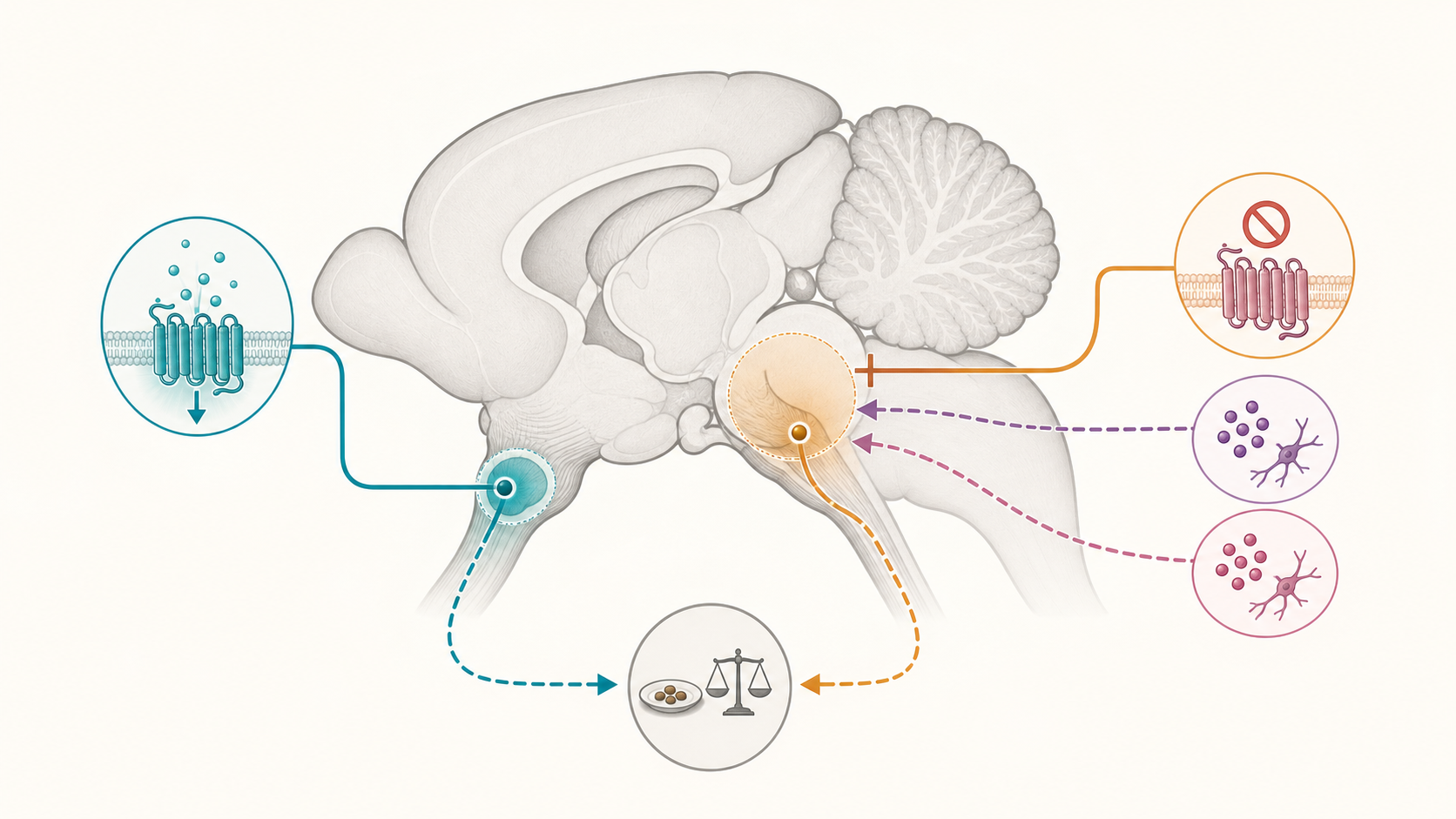
The mouse study supports two distinct neural routes, not two interchangeable versions of the same mechanism.
That helps explain the apparent GIP agonist vs antagonist paradox. It does not settle which strategy is better in people. The study was mechanistic animal research—not a human head-to-head trial, treatment guide, or proof that every GIP-containing drug program will work clinically.
Quick answer: Receptor pharmacology is only part of the story. Where the receptor sits, which circuit is engaged, what other pathway is targeted, which endpoint is measured, and which species is studied can all change the result. Opposite actions at GIPR can therefore converge on less eating or lower body weight through different routes.
Why does GIP agonist vs antagonist look like a paradox?
The paradox exists because activating and blocking the same receptor sound as if they should always produce opposite whole-body outcomes. Biology is rarely that tidy.
An agonist activates a receptor. An antagonist blocks activation. If every GIP receptor were in one uniform cell population controlling one output, opposite receptor actions might be expected to push that output in opposite directions.
But GIP receptors are distributed across different cell populations and tissues. Those cells sit inside networks that can inhibit, amplify, compensate for, or cooperate with other signals. A drug's observed effect is therefore the combined output of receptor location, circuit wiring, exposure, partner therapy, and time—not merely the words agonist or antagonist.
This distinction matters because clinical development has produced weight-loss signals from both directions. Tirzepatide combines GLP-1R and GIPR agonism and has established clinical efficacy for approved indications. GIPR-antagonist programs combined with GLP-1R agonism have also produced human weight-loss signals, although their products, evidence bases, safety profiles, and regulatory status are not interchangeable.[^nature]
The new paper asks a narrower question: could different brain regions help explain how these opposite GIPR strategies reach similar-looking endpoints in mice?
What did the 2026 mouse study test?
The researchers deleted the Gipr gene in either the area postrema or the hypothalamus, then tested how the mice responded to several peptide interventions. This conditional, region-targeted knockout design is closer to a circuit-mapping experiment than a drug-comparison trial.
The team used mice carrying a floxed Gipr gene and injected viral vectors expressing Cre recombinase into one of two regions:
- Area postrema (AP): a brainstem region outside the blood–brain barrier with many GIPR-expressing cells, most described as GABAergic in this context.
- Hypothalamus: a broader appetite-regulating region containing GIPR-expressing neurons behind the blood–brain barrier, including glutamatergic and GABAergic populations.
The experiments evaluated acute food intake, body-weight change, fat mass, metabolic measures, neuronal activation, and taste-avoidance behavior under different conditions. The interventions included long-acting acyl-GIP, a peptide GIPR antagonist, the GLP-1R agonist liraglutide, and the amylin analogue cagrilintide, sometimes alone and sometimes in combinations.[^nature]
Those are related endpoints, but they are not synonyms. A short-term reduction in food intake is not the same as durable weight loss. Neither automatically establishes long-term human efficacy, safety, tolerability, or clinical benefit.
What happened when GIPR was removed from the area postrema?
Removing GIPR from the area postrema largely removed the appetite-suppressing response to acyl-GIP. In control mice, acyl-GIP reduced food intake across several paradigms, including dark-phase feeding and refeeding after a fast. Those effects were absent or strongly blunted in area-postrema knockout mice.[^nature]
In mice with diet-induced obesity, chronic acyl-GIP also reduced body weight, food intake, and fat mass in controls, but not in mice lacking area-postrema GIPR. Acyl-GIP-induced neuronal activation in the area postrema was likewise largely abolished by the regional knockout.
The area postrema also mattered for an anti-aversive effect. Acyl-GIP reduced a conditioned taste-avoidance response triggered by PYY in control mice, but not after area-postrema GIPR deletion. That finding suggests this region may contribute to both appetite and nausea-related responses to GIPR agonism.
Crucially, deleting area-postrema GIPR did not erase liraglutide's effects or the extra response seen when the GIPR antagonist peptide was added to liraglutide. The area postrema therefore appeared necessary for the tested agonist route, but not for the tested antagonist combination route.
Mechanism takeaway: In these mice, area-postrema GIPR was a critical part of acyl-GIP's appetite- and weight-related effects. It was not the required target for the antagonist's added effect alongside liraglutide.
What happened when GIPR was removed from the hypothalamus?
Deleting hypothalamic GIPR left acyl-GIP's acute appetite suppression intact but changed responses to liraglutide and the antagonist combination. This is the mirror image that makes the paper informative.
Acyl-GIP still reduced food intake in the hypothalamic knockout mice. Yet when mice were moved to a high-fat diet and treated with liraglutide, those lacking hypothalamic GIPR lost more weight than controls. In control mice, adding the GIPR antagonist to liraglutide produced additional weight loss. In hypothalamic knockout mice, the antagonist no longer added further weight loss beyond the already enhanced liraglutide response.[^nature]
That pattern is consistent with the antagonist acting through a hypothalamic GIPR-dependent route. Genetically removing the receptor in that region partly resembled the sensitizing effect attributed to pharmacological antagonism, leaving little or no extra effect for the antagonist peptide to add.
The researchers also tested the amylin pathway. In wild-type mice, combining cagrilintide with the GIPR antagonist produced greater weight loss than cagrilintide alone. Mice lacking hypothalamic GIPR showed a larger and more sustained response to cagrilintide than controls. Together, those experiments extended the hypothalamic sensitization idea beyond GLP-1R agonism to an amylin-receptor agonist.
The authors also ablated brainstem preproglucagon neurons and found that this did not remove the tested antagonist effects. That result argues against a simple explanation in which GIPR antagonism works only by requiring central GLP-1 production.
Evidence table: what is established, and what did this study add?
The strongest clinical claims and the new circuit claims come from different evidence layers. Keeping them separate prevents a mouse mechanism paper from being mistaken for human comparative evidence.
| Claim | Evidence layer | What can reasonably be concluded | What cannot be concluded | |---|---|---|---| | Some incretin medicines produce clinically meaningful weight loss | Randomized human trials and regulatory review for specific products and indications | Specific approved medicines have demonstrated efficacy and characterized safety under studied conditions | That all GIP agonists, antagonists, combinations, or unapproved products share those benefits | | GIPR agonism plus GLP-1R agonism can work clinically | Human trial evidence for specific co-agonist medicines, including tirzepatide | Activating GIPR can be compatible with clinical benefit in a defined molecule and program | That GIPR agonism alone explains all benefit, or that every agonist design will translate | | GIPR antagonism plus GLP-1R agonism has human weight-loss signals | Human clinical-development evidence for specific investigational programs | Blocking GIPR is also a plausible development strategy in a specific combination context | That antagonism is proven superior, equivalent, safer, or appropriate for an individual | | Area-postrema GIPR mediated acyl-GIP appetite and weight responses | Conditional regional knockout experiments in mice | This region was required for key tested responses to GIPR agonism in these models | Durable human efficacy, human circuit equivalence, or a treatment recommendation | | Hypothalamic GIPR mediated the extra antagonist signal with liraglutide and influenced cagrilintide response | Conditional regional knockout and combination experiments in mice | A distinct hypothalamic route can explain added weight-related effects in these models | A human agonist-versus-antagonist ranking or proof that every combination uses this route |
For context on why animal mechanism data require a separate evidence label, see what preclinical actually means. For a broader distinction between regulated incretin medicines and loosely marketed research compounds, see GLP-1 peptides vs research peptides.
Why can opposite pharmacology reach a similar endpoint?
A shared endpoint does not imply a shared mechanism. Five variables help explain why.
- Receptor location: GIPR in the area postrema did not behave like GIPR in the hypothalamus. A drug can activate one relevant population while blocking another population changes the network differently.
- Neural circuit: Receptors sit inside excitatory and inhibitory circuits. Activating an inhibitory neuron and blocking a different inhibitory influence can both shift the final network toward less eating.
- Co-therapy: The antagonist's added signal appeared alongside liraglutide or cagrilintide. That is an interaction question, not evidence that the antagonist produces the same standalone mechanism as acyl-GIP.
- Endpoint: Acute food intake, body-weight change, fat mass, aversion, glucose tolerance, and durable disease outcomes measure different things. Similar movement in one endpoint can conceal major differences elsewhere.
- Species and experimental model: A targeted knockout in mice can reveal causal circuit involvement under controlled conditions. It cannot establish that human anatomy, exposure, behavior, compensatory biology, safety, or long-term benefit will match.
Think of it less like an accelerator versus a brake on one wheel and more like traffic control across a city. Opening one route and closing another can both reduce congestion downtown, but the paths and side effects may be completely different.
What the study does not show
The study does not tell readers to choose GIP agonism or antagonism. It also does not establish that the strategies are clinically interchangeable.
The experiments do not provide:
- a human head-to-head comparison;
- evidence for treatment selection, switching, or combining medicines;
- proof of durable human weight loss;
- comparative human safety or tolerability;
- evidence that every dual agonist or antagonist program will translate;
- support for self-experimentation, sourcing, purchasing, or dosing protocols.
The paper's sample sizes were relatively small, as the authors acknowledged, even though the findings were statistically significant and reproducible across their paradigms. Regional viral knockout also identifies necessary circuitry at the scale achieved by the targeting method; it does not fully resolve every cell subtype, connection, or downstream interaction.
The bottom line
The GIP agonist vs antagonist paradox becomes less paradoxical once receptor location and circuit context are included. In the July 2026 mouse study, area-postrema GIPR was critical for appetite suppression from acyl-GIP, while hypothalamic GIPR was involved in the extra weight-related response associated with antagonism alongside liraglutide and in altered responsiveness to cagrilintide.
That is a useful mechanism lesson: two interventions can push the same scale reading in the same direction without being mechanistically equivalent. The next questions—durability, safety, tolerability, comparative benefit, and usefulness for people—require human clinical evidence for each specific product and strategy.
Educational note: This article explains evidence and mechanism. It does not provide medical advice, treatment selection, dosing, switching, sourcing, purchasing, or protocol guidance.
Frequently asked questions
Are GIP agonists and antagonists the same thing?
No. Agonists activate GIPR, while antagonists block it. Similar weight-related outcomes can arise through different receptor populations, circuits, and combination effects.
Did the study prove that both strategies work equally well in humans?
No. It was a mouse circuit study, not a human efficacy comparison. Human conclusions must come from trials of specific drug candidates.
Did both strategies reduce food intake by the same pathway?
The results argue against that interpretation. Acyl-GIP appetite suppression required area-postrema GIPR, while the antagonist's added weight-loss effect with liraglutide required hypothalamic GIPR.
Does reduced food intake prove durable clinical benefit?
No. Food intake is one experimental endpoint. Durable clinical benefit also depends on sustained efficacy, safety, tolerability, adherence, and outcomes meaningful to patients.
Sources
[^nature]: Lewis JE, Montaner M, Nuzzaci D, et al. “Distinct brain regions mediate regulation of food intake in response to GIPR agonism or antagonism.” Nature Metabolism. Published July 24, 2026. https://doi.org/10.1038/s42255-026-01575-z