Is MOTS-c a Host-Defense Peptide? What the New MRSA Study Actually Shows
The new eLife paper makes a credible preclinical case that MOTS-c has host-defense-peptide properties. It does not show that MOTS-c treats infections in people. Researchers reported direct effects on E. coli and methicillin-resistant Staphylococcus aureus (MRSA), changes in monocyte and macrophage biology, and survival in mice challenged with MRSA that had been exposed to MOTS-c before inoculation.
That last detail is the hinge of the whole story. The mice did not first develop an infection and then receive MOTS-c as therapy. The bacteria were mixed with MOTS-c immediately before being injected into the animals. This design can test whether pre-exposure reduces bacterial infectivity; it cannot establish MOTS-c as a conventional post-infection treatment.
Quick answer: Calling MOTS-c a host-defense peptide is supported by converging biochemical, bacterial, cellular, and animal findings. Calling it an antibiotic, immune therapy, or proven infection treatment would run far beyond the data.
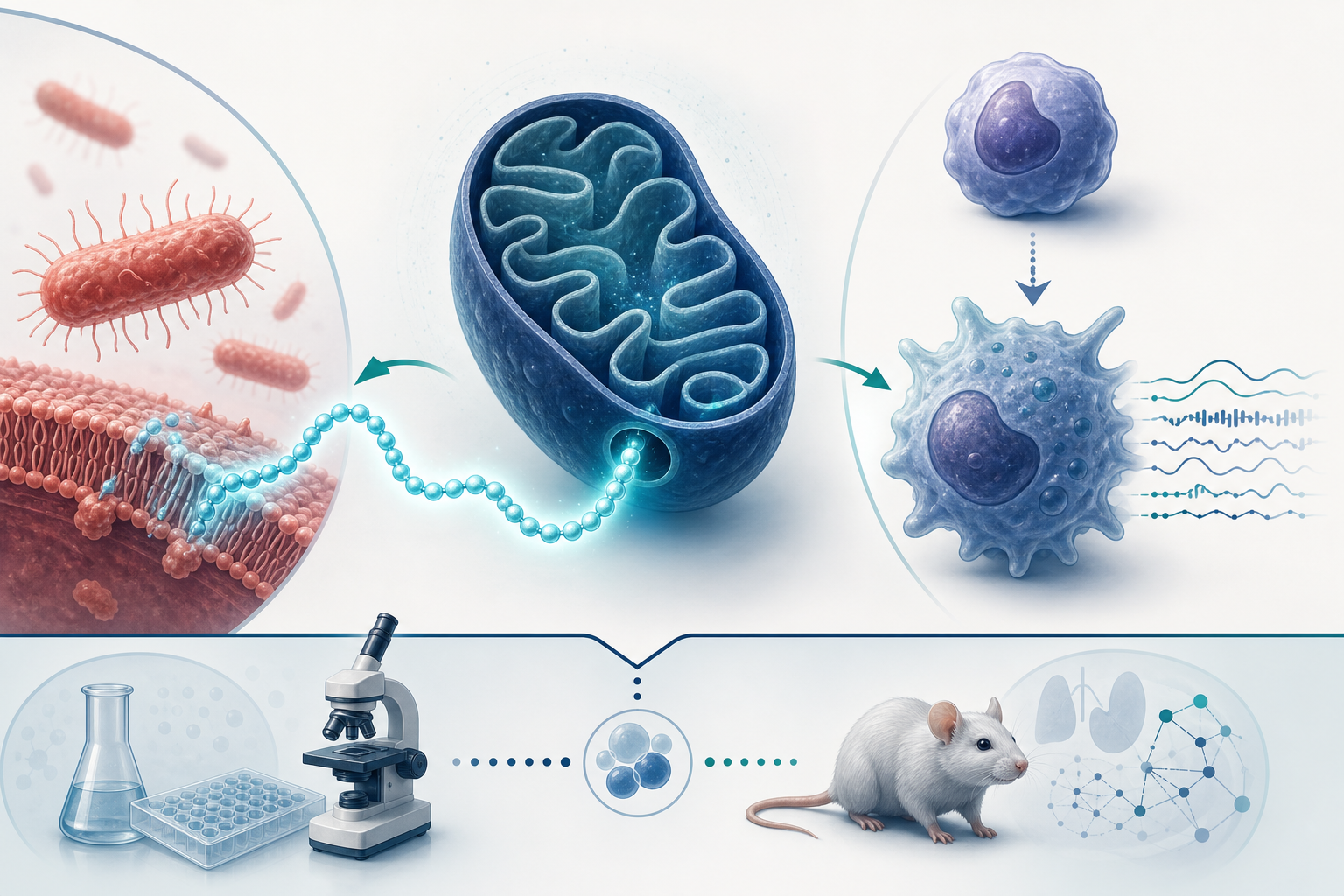
The study connects three preclinical layers: direct bacterial effects, immune-cell changes, and animal challenge experiments. None is a human treatment trial.
In This Guide
- What is the new publication?
- Why call MOTS-c a host-defense peptide?
- What did the bacterial experiments show?
- What did the mouse survival experiment test?
- What happened in human monocytes?
- What happened in mouse macrophages?
- How strong is the evidence?
- What remains unknown?
What Is New About the MOTS-c Study?
The formal publication is new, but the underlying work is not entirely new. The article, “MOTS-c is a mitochondrial-encoded interferon-linked host defense peptide,” became an eLife Version of Record on August 18, 2026. The manuscript had been sent for peer review in March 2023 and circulated through eLife’s reviewed-preprint process before final publication.
That timeline matters. “New study” can mean a new dataset, a new preprint, a revised manuscript, or a final journal record. Here, the August 2026 event is the Version of Record, with the full article, supplements, public review, and author response assembled into the formal publication history. It should not be described as though every finding first appeared in August 2026.
MOTS-c itself is a 16-amino-acid peptide encoded within the mitochondrial 12S rRNA region. It was previously discussed mainly in relation to metabolism, cellular stress, and aging. The new paper broadens that picture by arguing that MOTS-c also fits the biological category of a host-defense peptide.
For broader biological context, our MOTS-c explainer covers the peptide's mitochondrial origin and earlier metabolism research without treating those findings as proof of clinical benefit.
Why Do the Authors Call MOTS-c a Host-Defense Peptide?
MOTS-c has both the chemical features and the reported functions expected of a host-defense peptide. Host-defense peptides—often also called antimicrobial peptides—are generally short peptides that can interact with microbes directly and can also influence immune-cell behavior.
The paper describes MOTS-c as:
- amphipathic, with a hydrophobic core at residues 8–11;
- cationic, carrying a net positive charge of about +3 at physiological pH, largely through its C-terminal basic residues;
- able to associate with and aggregate selected bacteria;
- able to disturb bacterial membranes and metabolism in laboratory conditions; and
- able to change monocyte-to-macrophage programs after exogenous exposure.
The authors strengthened the structure-function argument with altered MOTS-c sequences. Replacing either the hydrophobic core or cationic tail with alanines reduced bacterial aggregation and reversed effects on E. coli growth. Higher salt also weakened activity, consistent with ionic interactions being important.
That is a coherent host-defense-peptide pattern. It remains a classification supported by preclinical experiments, not a clinical designation or regulatory approval.
What Did the Bacterial Experiments Show?
In laboratory systems, MOTS-c interacted with E. coli and MRSA and impaired bacterial integrity and growth under specific exposure conditions. The researchers reported rapid bacterial association and aggregation, membrane blebbing under electron microscopy, increased membrane permeability, reduced cellular ATP, altered respiration and glycolysis, and slower E. coli proliferation.
The direct-bacterial evidence was built from several controls:
- water or vehicle controls;
- dose-response experiments;
- salt conditions that disrupted ionic interactions;
- mutant peptides lacking the hydrophobic or cationic domains;
- different bacterial growth phases;
- an inducible construct expressing MOTS-c inside E. coli; and
- comparisons across bacterial species.
The effects were not universal. At 100 µM, MOTS-c aggregated E. coli but not Salmonella typhimurium or Pseudomonas aeruginosa in the reported assay. That selectivity is useful evidence against a vague “kills all bacteria” story.
Many bacterial experiments used 100 µM MOTS-c, often with bacteria washed and suspended in water. Reported biological replicate counts commonly ranged from n=3 to n=8 depending on the assay. Those conditions help probe mechanism, but they do not establish an effective concentration in human tissue, an effective human dose, or a usable route of administration.
Bacterial-evidence answer: The experiments support direct, sequence-dependent antibacterial activity against selected organisms in controlled laboratory conditions. They do not establish a clinically useful antibiotic.
What Did the Mouse Survival Experiment Actually Test?
The animal experiment tested MRSA infectivity after direct pre-exposure to MOTS-c—not MOTS-c treatment after infection. This is the most important design fact in the paper.
For the main experiment, mid-log-phase MRSA was suspended in either 100 µM MOTS-c, water vehicle, or water followed by heat killing. The preparations were then immediately injected into the peritoneum of six-month-old female C57BL/6J mice. Group sizes were n=5–6.
The reported outcomes were striking: only 16.67% of mice receiving vehicle-exposed MRSA survived, whereas all mice receiving MOTS-c-exposed MRSA or heat-killed MRSA survived over 72 hours. The MOTS-c-exposed MRSA preparation produced 3.4-fold fewer colonies when sampled before injection. Mice in that group still lost weight and showed an inflammatory response, suggesting that the preparation was not simply inert.
The authors also reported a male replication using younger C57BL/6J mice, with n=4–5 per live-MRSA group. Survival was 20% with control MRSA and 100% with MOTS-c-exposed MRSA; the sampled inoculum showed a 19.8-fold colony-count reduction. A separate male live-versus-heat-killed comparison used n=10.
The controls and measurements add useful context. The study tracked weight, circulating cytokines, blood urea nitrogen, AST, and ALT. At 72 hours, the control comparisons were constrained because only one control mouse survived. Statistical methods included log-rank tests for survival, repeated-measures two-way ANOVA for weight, Mann–Whitney tests for colony counts, and Kruskal–Wallis or Mann–Whitney tests for selected blood measures.
The experiment supports the conclusion that contact with MOTS-c reduced the pathogenicity of the MRSA preparation enough for these mice to survive the challenge. It does not answer whether giving MOTS-c later would treat an established infection, whether it reaches an infection site in a living organism, or whether it improves outcomes compared with standard antibiotics.
Design-limit answer: “MOTS-c-treated MRSA protected mice” is accurate only if “treated” refers to the bacteria. The study did not administer MOTS-c as post-infection therapy to the mice.
What Did the Human Monocyte Experiments Find?
Human monocyte experiments linked endogenous MOTS-c expression to activation and differentiation signals, but most mechanistic work relied on cells rather than people. Primary human peripheral-blood monocytes showed increased MOTS-c during macrophage differentiation with M-CSF (n=3). In the THP-1 transformed human monocytic cell line, MOTS-c increased after differentiation with PMA and after stimulation with LPS, interferon-gamma, or both; reported replicate counts ranged from n=6 to n=12.
The paper also reported movement of endogenous MOTS-c into the nucleus after activation or differentiation. Fluorescent and tagged exogenous MOTS-c entered THP-1 cells and localized to the nucleus. In bulk RNA sequencing, THP-1 cells were primed with 10 µM MOTS-c for two hours and then exposed to PMA with or without MOTS-c for another two hours (n=6). The resulting expression changes overlapped with, but were not identical to, ordinary differentiation signals.
The public review drew a sharp distinction here. Reviewer 1 described the antibacterial methods and findings as convincing but considered the monocyte-differentiation conclusions less secure. Specific concerns included the heavy use of THP-1 cells, the artificial PMA differentiation system, adherence to plastic as a limited differentiation readout, and uncertainty about physiological relevance.
The authors clarified vehicle controls, added biological-replicate information, added a nuclear-fraction contamination control, supplied differential-expression tables, and acknowledged that further work is needed. That exchange is part of the evidence, not backstage paperwork.
What Did the Mouse Macrophage Experiments Find?
Exogenous MOTS-c exposure during differentiation changed macrophage gene programs and bacterial-clearance behavior, but it did not test infection treatment in a whole animal. These experiments asked what happens when developing monocytes or macrophages encounter MOTS-c in culture.
In THP-1-derived macrophages, a single 10 µM exposure during differentiation was associated with improved clearance of internalized E. coli in a gentamicin-protection assay (n=6), altered cytokine responses after LPS, and changes in oxygen consumption. Primary human monocytes exposed during M-CSF-driven differentiation also showed altered adherence, although that is not a complete measure of macrophage identity.
For mouse work, bone-marrow-derived macrophages from young and old mice of both sexes were differentiated with 10 µM MOTS-c or water vehicle. MOTS-c was present during the first three days of a seven-day differentiation. Single-cell RNA sequencing identified populations enriched for antigen-presentation and interferon-related signatures.
Those transcriptomic findings suggest an immunomodulatory role worth investigating. They do not establish how endogenous MOTS-c functions in an intact organism, how long any programming lasts, or whether such changes improve clinical infection outcomes. The reviewer also questioned whether some apparent differences were driven mainly by age rather than MOTS-c; the authors argued that MOTS-c shifted related programs across age and sex groups.
The raw sequencing data are publicly listed under NCBI BioProject accessions PRJNA623667 and PRJNA769064, and analytical code is available through the Benayoun laboratory’s GitHub repository.
How Strong Is the Evidence for MOTS-c as a Host-Defense Peptide?
The classification is supported by converging preclinical evidence, but the therapeutic translation is very uncertain. The most defensible evidence ladder looks like this:
| Evidence layer | What it supports | What it does not support | |---|---|---| | Peptide chemistry | MOTS-c has amphipathic and cationic features typical of host-defense peptides | Activity in a living person | | Bacterial assays | Direct interaction with selected bacteria, membrane disruption, and growth effects under specified conditions | A practical antibiotic concentration, route, or formulation | | Mouse challenge | MRSA pre-exposed to MOTS-c was less lethal in acute peritonitis experiments | Post-infection treatment or comparison with standard care | | Human-cell work | MOTS-c expression responds to IFN-gamma, LPS, and differentiation cues; exogenous peptide affects THP-1 programs | A clinical immune effect in people | | Mouse-cell transcriptomics | Exogenous MOTS-c during differentiation shifts macrophage populations and interferon/antigen-presentation signatures | Durable benefit, whole-animal efficacy, or human effectiveness |
The paper’s broad biological claim—that a mitochondrial-encoded peptide can participate in host defense—is more strongly supported than any claim about MOTS-c as a medicine. That distinction is not nitpicking. It is the difference between discovering a function and developing a treatment.
For a broader method, see our guide to evaluating peptide claims online. The same rule applies: identify the exact model, intervention timing, endpoint, comparator, and evidence tier before accepting the headline.
What Does This Study Not Establish?
The study does not establish MOTS-c as an antibiotic, immune therapy, infection treatment, or consumer product. It also does not provide:
- an effective human dose;
- a validated route or formulation;
- evidence of durability;
- comparative benefit against antibiotics or other therapies;
- clinical safety in infected people;
- a diagnosis or treatment role for MRSA or any other infection; or
- grounds for purchasing, sourcing, compounding, or self-administration.
Toxicity observations were limited and model-specific. In the mouse challenge, MOTS-c-exposed MRSA still caused weight loss and an intermediate inflammatory response, while kidney and liver injury markers were not significantly worse than in the heat-killed group at 72 hours. That is not a general MOTS-c safety study. The researchers used synthetic MOTS-c reported as greater than 95% pure by mass spectrometry, but product purity in one laboratory does not establish clinical manufacturing quality or safety.
Funding came from multiple public and philanthropic sources, including the National Institute on Aging, National Institute of General Medical Sciences, American Federation for Aging Research, Larry L. Hillblom Foundation, Pew Charitable Trusts, AADOCR, Hevolution, and others. The article states that funders had no role in study design, data collection and interpretation, or the publication decision. Most authors declared no competing interests; Bérénice Benayoun disclosed serving as an eLife reviewing editor, and Changhan Lee disclosed being a consultant and shareholder of CohBar, Inc.
Bottom Line
Yes—MOTS-c now has a serious preclinical case for being described as a mitochondrial-encoded host-defense peptide. No—the study did not prove that MOTS-c treats MRSA or any infection in humans.
Its strongest contribution is biological: MOTS-c appears to do more than participate in metabolism. It can interact directly with selected bacteria in laboratory conditions, its expression responds to immune cues in monocytes, and exogenous exposure can alter macrophage programs.
Its strongest evidence-literacy lesson is methodological: bacteria exposed to MOTS-c before animal inoculation are not the same as an established infection treated afterward. Until conventional therapy experiments and human clinical studies exist, the host-defense finding should expand the research map—not the medicine cabinet.
FAQ
Is MOTS-c a host-defense peptide?
The 2026 eLife paper provides converging preclinical evidence that MOTS-c has the chemistry and functions of a host-defense peptide. That conclusion is based on biochemical, bacterial, cell-culture, and mouse experiments, not human clinical trials.
Did MOTS-c cure MRSA infection in mice?
That wording is misleading. MRSA was mixed with MOTS-c before being injected into mice. The experiment showed reduced infectivity of a pre-exposed bacterial preparation; it did not test MOTS-c given after an infection was established.
Did the study test MOTS-c in people?
No treatment trial was conducted in people. The human evidence consisted of experiments using primary human monocytes and the THP-1 cell line.
Does the study establish an effective MOTS-c dose?
No. Concentrations used in bacterial and cell experiments cannot be converted into a proven human dose, route, schedule, or formulation.
Was the August 2026 publication the first release of these findings?
No. The work circulated through eLife’s reviewed-preprint process beginning in 2023. August 18, 2026 marks the Version of Record.
Does this article recommend MOTS-c for infection?
No. It is an evidence-literacy article and provides no infection diagnosis, antimicrobial treatment guidance, dosing, sourcing, purchasing, or individualized medical advice.