What Is CJC-1295? DAC vs No-DAC, Ipamorelin Combinations, and Evidence
CJC-1295 is a synthetic analog of growth hormone-releasing hormone, usually discussed because it can stimulate the GH/IGF-1 axis in controlled research settings. The phrase sounds simple, but the search results are not. People use CJC-1295, CJC-1295 with DAC, CJC-1295 no DAC, and CJC-1295 ipamorelin as if they are clean, interchangeable labels. They are not.
The safest way to read the topic is this: CJC-1295 is best understood as an investigational growth-hormone-releasing hormone analog with limited human evidence, lots of online wellness claims, and major naming confusion. This article is educational only. It is not medical advice, treatment guidance, dosing guidance, purchasing guidance, or a recommendation to use any peptide.
Quick answer: what is CJC-1295?
CJC-1295 is a modified growth hormone-releasing hormone analog developed to stimulate growth hormone release and raise downstream IGF-1 markers. In the stricter research sense, CJC-1295 is usually associated with a drug-affinity complex, often shortened to DAC, which makes it longer acting. Online, however, “CJC-1295 no DAC” is often used for a related shorter-acting GHRH analog such as modified GRF (1-29), not always for the exact same compound.
CJC-1295 is commonly searched with ipamorelin because they are discussed as acting through different parts of growth-hormone signaling: one through GHRH-style signaling, the other as a growth hormone secretagogue. That mechanism-based pairing does not automatically prove clinical outcomes, safety, or usefulness.
CJC-1295 with DAC vs no-DAC
The DAC distinction is the first thing to understand because it changes what a source may be talking about. DAC stands for drug-affinity complex. In plain English, it refers to a modification intended to bind circulating proteins and extend how long the molecule remains active in the body. In research literature, CJC-1295 is commonly described as a long-acting GHRH analog because of this design.
“No-DAC” is where the language gets sloppy. In many online discussions, “CJC-1295 no DAC” is used as a casual label for modified GRF (1-29), a shorter-acting GHRH analog. Some pages treat it as a variant of CJC-1295; others use it as shorthand for a different but related compound. That matters because evidence, pharmacology, side-effect assumptions, and claim boundaries can drift when labels are blurred.
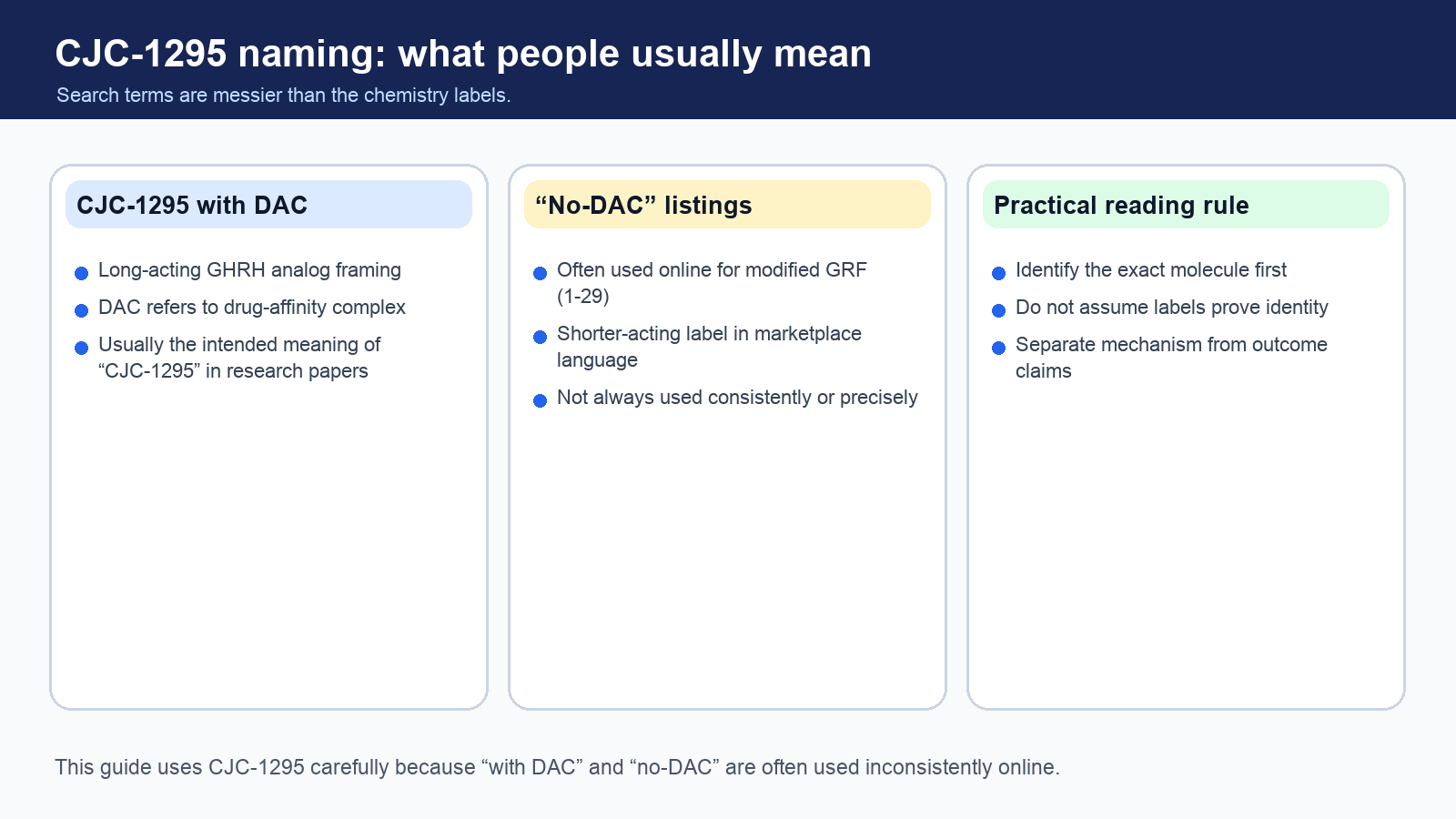
For readers, the practical rule is simple: do not evaluate a claim until you know what molecule the claim is actually about. “CJC-1295” in a study, “CJC-1295 with DAC” in a clinic article, and “CJC-1295 no DAC” in a forum or vendor-style page may not be interchangeable. The internet loves turning chemistry into nickname soup. Very efficient if your goal is confusion.
How CJC-1295 is supposed to work
CJC-1295 is discussed as a GHRH analog. GHRH is part of the body’s normal signaling system that helps regulate growth hormone release from the pituitary. A GHRH analog is meant to interact with that pathway rather than replacing growth hormone directly.
The downstream marker people focus on is IGF-1, which is influenced by growth hormone signaling. Human studies of CJC-1295 have reported changes in GH and IGF-1 markers, which is important pharmacology evidence. But a hormone marker moving is not the same thing as proving anti-aging, fat loss, muscle gain, recovery, sleep, injury healing, or performance outcomes.
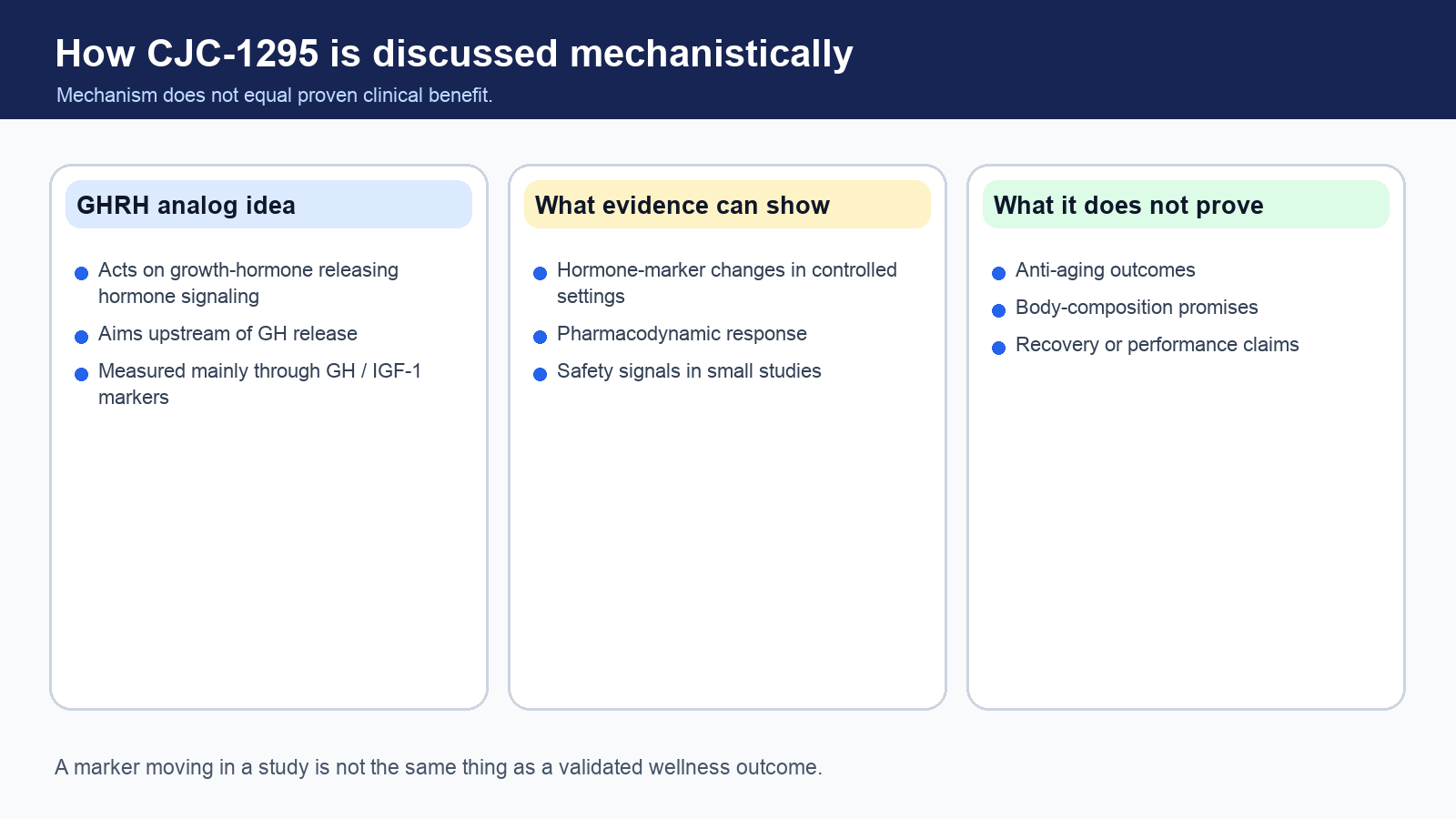
That distinction is the whole article, frankly. Mechanism is not magic. Mechanism tells you why a compound is scientifically interesting. It does not tell you that broad consumer claims are true, safe, durable, or clinically meaningful.
Why CJC-1295 is searched with ipamorelin
CJC-1295 is often searched alongside ipamorelin because the two are marketed and discussed as complementary growth-hormone-axis compounds. CJC-1295 is framed around GHRH-style signaling. Ipamorelin is framed as a growth hormone secretagogue that acts through a different receptor pathway associated with ghrelin signaling; the sermorelin-versus-ipamorelin comparison provides further pathway context without implying that either compound has proven wellness benefits.
That makes the pairing easy to explain from a mechanism standpoint: two different upstream signals, one shared interest in growth hormone release. It also makes the pairing easy to over-market. A plausible combination story is not the same as direct evidence that a combination improves health, recovery, body composition, aging markers, or any other outcome that appears in wellness copy.
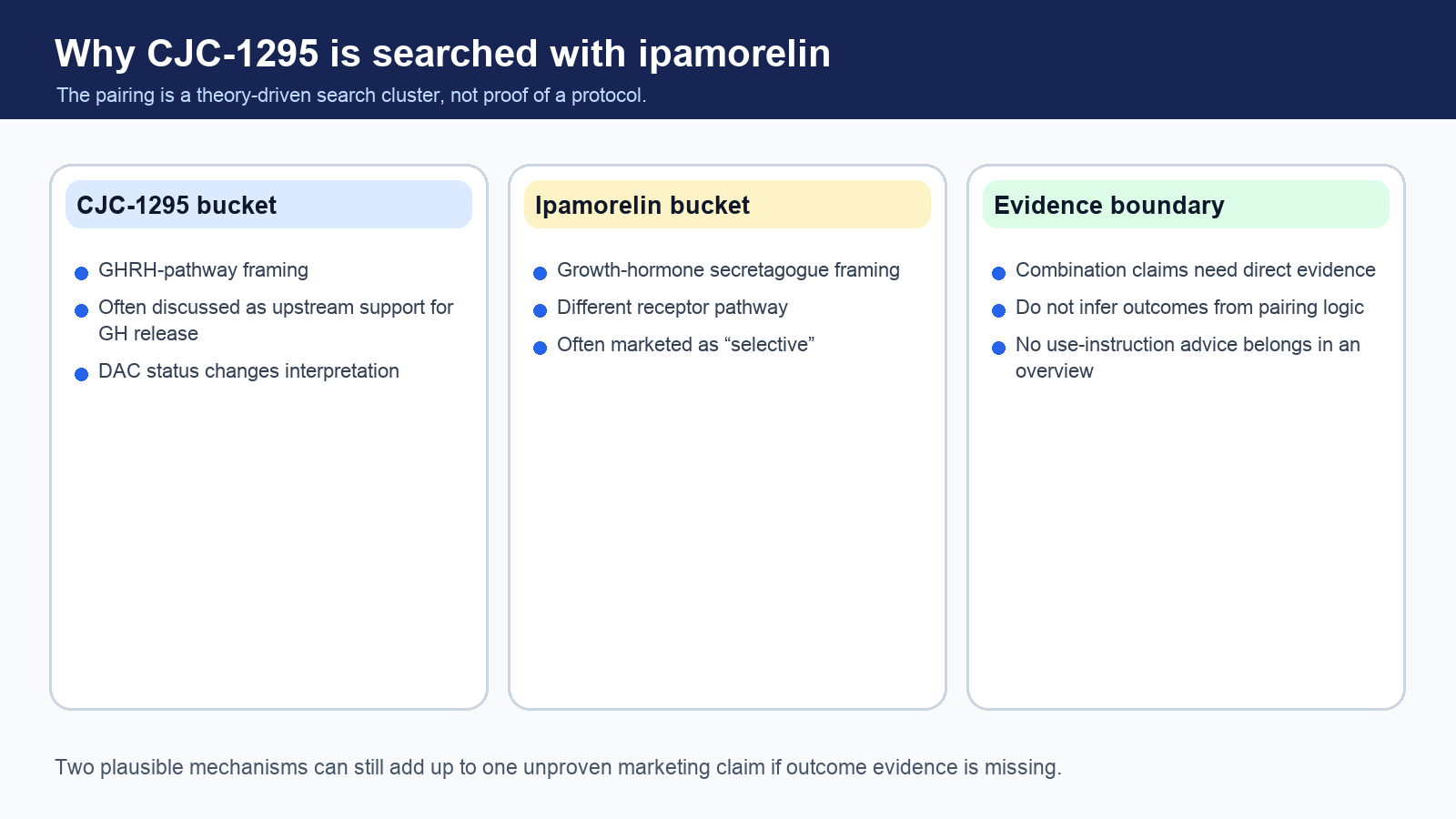
If you see CJC-1295 plus ipamorelin claims, separate the statement into three parts: what is known about CJC-1295 alone, what is known about ipamorelin alone, and what has actually been studied about the combination. If the combination evidence is not direct, the claim should stay cautious.
This page does not provide combination scheduling logic, product advice, or use instructions. The point is to understand why the search cluster exists, not to turn the search cluster into a plan.
What the evidence actually says
The evidence around CJC-1295 is strongest for a narrow question: can this kind of long-acting GHRH analog affect GH and IGF-1 markers in humans under study conditions? Published human research supports that basic pharmacodynamic idea. It is much weaker for the broad claims commonly attached to the compound online.
Small or early-stage human studies can be useful without being definitive. They can show that a pathway responds. They can identify short-term tolerability signals. They can suggest what researchers might study next. They cannot carry every claim that wellness marketing wants to stack on top of them.
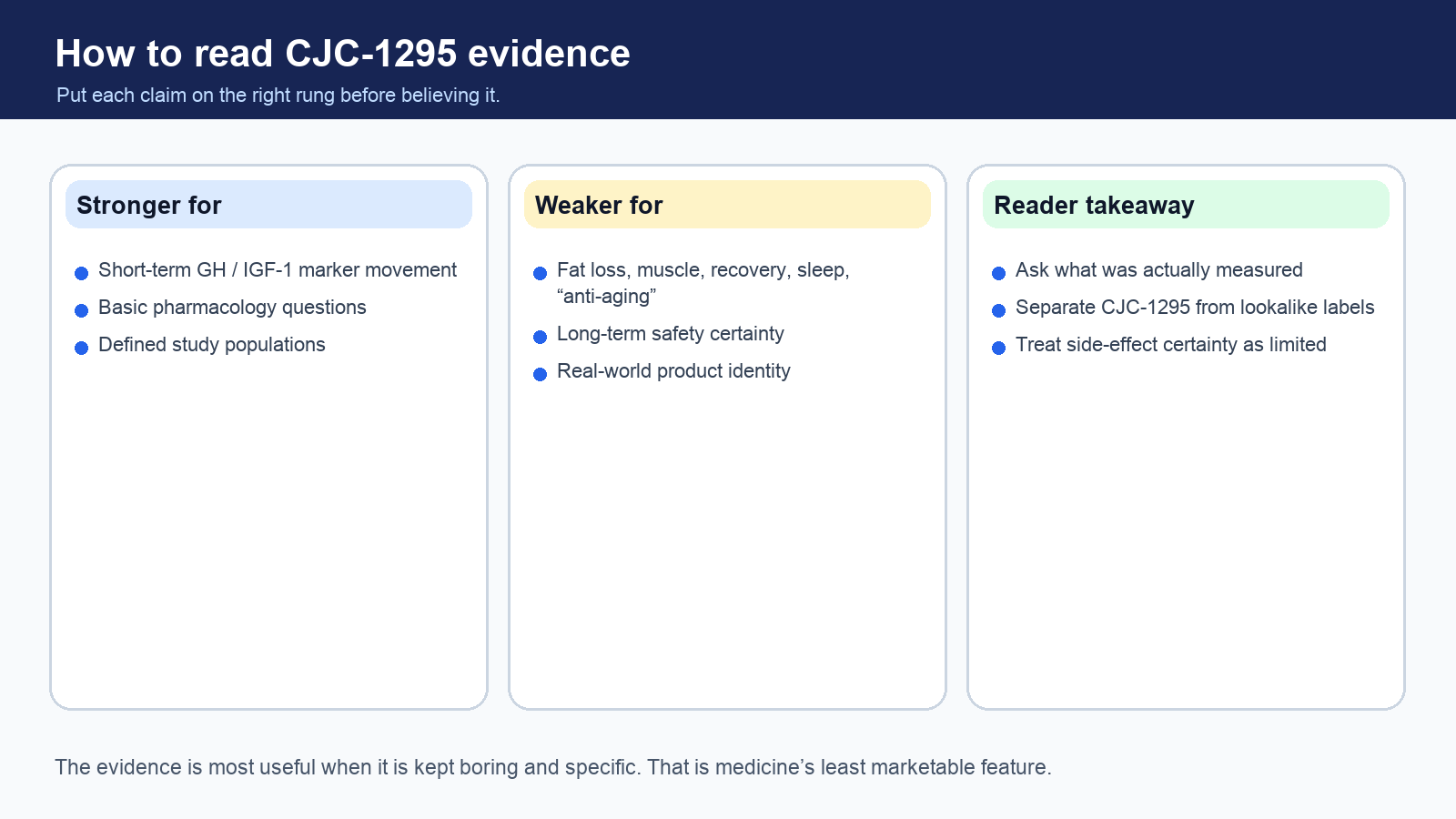
For CJC-1295, the cautious evidence read is:
- GH and IGF-1 marker changes are more plausible than sweeping outcome claims.
- Evidence for anti-aging, fat loss, muscle gain, recovery, sleep, or performance should be treated as limited unless tied to direct human outcome studies.
- Evidence for “CJC-1295 with DAC” should not automatically be transferred to “no-DAC” marketplace language.
- Evidence for CJC-1295 alone should not automatically be transferred to CJC-1295 with ipamorelin combinations.
- Long-term safety certainty is not established by short-term marker studies.
That is not anti-peptide. It is just not letting the marketing department drive the bus with a lab coat on.
CJC-1295 side effects and uncertainty
Side-effect discussions around CJC-1295 are often too confident. Because the compound is discussed through GH/IGF-1 signaling, many theoretical concerns overlap with broader growth-hormone-axis questions: fluid retention, joint discomfort, numbness or tingling, headaches, changes in glucose or insulin sensitivity, and other hormone-marker-related effects. Study reports and online reports may also mention local reactions or general symptoms, but real-world reports are not the same as controlled safety data.
The bigger issue is uncertainty. Side effects depend on the exact compound, product identity, purity, population, health status, other substances, and duration of exposure. Many online claims collapse all of that into a tidy “side effects are mild” sentence. That is not evidence-aware; that is just confidence wearing rented shoes.
People with endocrine conditions, cancer history, diabetes risk, sleep apnea concerns, cardiovascular risk, or other medical complexity should be especially skeptical of casual claims about GH-axis compounds. That sentence is not a hidden recommendation to use physician supervision as a shopping strategy. It is a reminder that this is biology, not a supplement-label word game.
Claim boundaries: what not to infer
Do not infer that CJC-1295 treats growth hormone deficiency, reverses aging, heals injuries, builds muscle, burns fat, improves sleep, or improves recovery unless a specific claim is supported by direct, relevant evidence and appropriate regulatory status. A compound can affect a hormone marker and still fail to prove meaningful outcomes.
Do not infer that search popularity equals clinical legitimacy. CJC-1295 is searched because the GH/IGF-1 pathway is interesting, because the DAC/no-DAC naming is confusing, and because CJC-1295 with ipamorelin is heavily discussed in wellness and performance-adjacent spaces. Search demand is a map of curiosity and marketing pressure, not a verdict.
Do not infer that a peptide label proves product identity. For research compounds and non-approved marketplace products, identity and quality are part of the risk discussion. This article does not help readers find, buy, compound, prepare, or use CJC-1295.
How to read CJC-1295 claims safely
When reading a CJC-1295 article, study, clinic page, or social post, ask these questions:
- Is the source talking about CJC-1295 with DAC, “no-DAC,” modified GRF (1-29), or something undefined?
- Is the claim based on GH/IGF-1 marker movement or on direct human outcomes?
- Is ipamorelin being added as a studied combination or as a mechanism-based marketing story?
- Are side effects described with uncertainty, or brushed away too neatly?
- Does the page avoid instructions, sourcing, and treatment claims, or is it quietly trying to sell a protocol?
A trustworthy educational page should make the topic clearer and less exciting. That sounds backward, but it is usually the tell. The more a page turns CJC-1295 into a universal optimization tool, the more work the evidence should have to do.
FAQ
Is CJC-1295 the same as CJC-1295 no DAC?
Not always. In stricter usage, CJC-1295 is commonly associated with DAC, the longer-acting drug-affinity-complex modification. Online, “CJC-1295 no DAC” is often used for modified GRF (1-29) or related shorter-acting GHRH analog language. Always check what exact molecule is being discussed.
Why do people combine CJC-1295 and ipamorelin in searches?
They are commonly searched together because they are discussed as acting through different upstream growth-hormone signaling pathways. That mechanism-based logic does not prove combination benefits, safety, or clinical usefulness.
Does CJC-1295 increase growth hormone or IGF-1?
Published human research has reported GH and IGF-1 marker increases with CJC-1295 in controlled settings. Marker changes should not be treated as proof of broader claims such as anti-aging, fat loss, recovery, or performance benefits.
What are CJC-1295 side effects?
Side-effect certainty is limited. Possible concerns are usually discussed in relation to GH/IGF-1 pathway effects, including fluid retention, joint discomfort, numbness or tingling, headaches, and glucose or insulin-sensitivity questions. Exact risk depends on compound identity, health status, exposure context, and evidence quality.
Is CJC-1295 approved as a treatment?
Readers should not assume CJC-1295 is approved for wellness, anti-aging, body-composition, or recovery use. Regulatory status depends on jurisdiction and product context. This article does not provide treatment, sourcing, or use advice.
Bottom line
CJC-1295 is scientifically interesting because it sits near the GH/IGF-1 pathway and has human marker evidence. It is also easy to overstate because the search ecosystem blends DAC/no-DAC naming, ipamorelin combinations, side-effect uncertainty, and wellness claims into one messy pile.
The clean read is: define the exact compound first, separate marker evidence from outcome evidence, keep CJC-1295 and ipamorelin combination claims on a short leash, and treat safety certainty as limited. If a source makes CJC-1295 sound simple, complete, and ready to solve everything, that is not clarity. That is a brochure with a chemistry hat.