Sermorelin vs Ipamorelin: What’s the Difference?
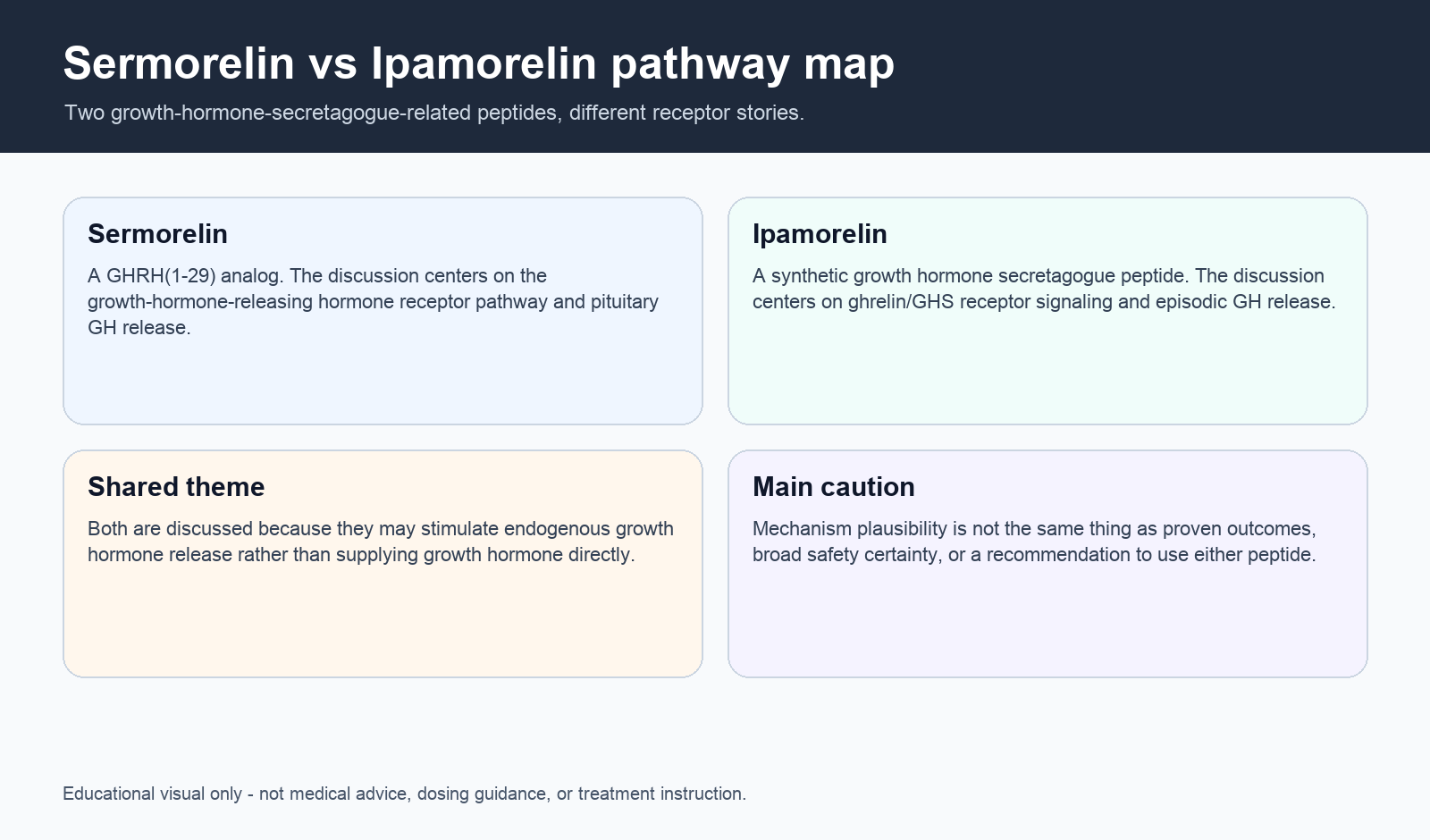
Sermorelin and ipamorelin are often compared because both sit in the growth-hormone-secretagogue conversation. The cleanest difference is mechanism: sermorelin is a growth-hormone-releasing hormone analog, while ipamorelin is usually described as a selective growth hormone secretagogue peptide acting through the ghrelin/GHS receptor pathway.
That difference is useful, but it does not make either peptide a proven anti-aging, recovery, body-composition, or wellness treatment. Most online comparisons jump too quickly from “may stimulate growth hormone release” to “therefore useful for X.” That is the part to slow down. Mechanism is not the same thing as outcome evidence, safety certainty, regulatory clarity, or medical advice.
This article is educational only. It does not provide protocols, dosing, sourcing guidance, treatment recommendations, or advice about whether to use either peptide.
Quick answer
Sermorelin and ipamorelin are both discussed as ways to stimulate endogenous growth hormone release, but they are not the same type of peptide.
| Question | Sermorelin | Ipamorelin | |---|---|---| | Common class description | GHRH analog, often described as GHRH(1-29) | Growth hormone secretagogue peptide / ghrelin receptor agonist | | Main pathway story | Acts through the GHRH receptor pathway upstream of pituitary GH release | Acts through the growth hormone secretagogue / ghrelin receptor pathway | | Why people compare it | Both are discussed around GH pulses, IGF-1 signaling, aging clinics, and “GH optimization” claims | Same | | Evidence problem | Mechanism and clinical history do not equal broad wellness proof | Selective secretagogue data do not equal broad wellness proof | | Safety problem | Endocrine effects and off-label/compounded context require caution | Endocrine effects, limited public clinical use data, and compounding context require caution |
A plain-language way to think about it: sermorelin tries to imitate part of the body’s growth-hormone-releasing signal; ipamorelin belongs to the growth hormone secretagogue family tied to ghrelin-receptor signaling. Both are more complicated than the marketing usually makes them sound.
Why people compare sermorelin and ipamorelin
People compare sermorelin and ipamorelin because both are commonly discussed in clinics, forums, and peptide content around growth hormone, IGF-1, body composition, recovery, sleep, aging, and “optimization.” They are also sometimes mentioned near CJC-1295, GHRP-2, GHRP-6, ibutamoren, and other growth-hormone-secretagogue-related compounds.
Readers encountering that comparison can use our CJC-1295 guide to distinguish DAC, no-DAC, and the rationale behind pairing CJC-1295 with ipamorelin.
That comparison can be useful if the question is mechanical: which pathway is being discussed? It becomes less useful when the question turns into “which one should I take?” or “which one is better?” Those are medical and personal-risk questions, and the public evidence base does not support simple consumer recommendations.
The better comparison is:
- What is each peptide supposed to signal?
- What kind of evidence supports that mechanism?
- What outcomes are being claimed beyond the evidence?
- What safety and regulatory uncertainty is being glossed over?
That last question is usually where the marketing gets quiet. Funny how that works.
What sermorelin is
Sermorelin is commonly described as a synthetic fragment or analog of growth-hormone-releasing hormone, often referred to as GHRH(1-29). In simple terms, it is discussed as a signal aimed at the GHRH receptor pathway involved in pituitary growth hormone release.
That does not mean sermorelin is the same as growth hormone. It also does not mean that every clinic claim about energy, sleep, fat loss, recovery, or anti-aging follows from the mechanism. A pathway can be biologically real while the marketing around it is still wildly overconfident.
Sermorelin has a different history from many gray-market peptides because it has been discussed in relation to growth hormone deficiency testing and medical contexts. But readers should be careful: historical or clinical context does not automatically validate modern wellness claims, compounded-product claims, or off-label marketing claims.
What ipamorelin is
Ipamorelin is usually described as a synthetic growth hormone secretagogue peptide and a ghrelin receptor, or GHS receptor, agonist. It is part of the broader family of compounds studied for their ability to stimulate growth hormone release through secretagogue signaling rather than by supplying growth hormone directly.
The common online pitch is that ipamorelin is more “selective” or “clean” than older growth hormone releasing peptides. That may reflect the way it is discussed in pharmacology literature, but it still should not be converted into casual safety certainty. Selective does not mean risk-free. A cleaner receptor story does not equal proven long-term safety in broad real-world use.
Ipamorelin also appears in regulatory and compounding discussions, which matters because many consumer-facing peptide claims happen outside a simple FDA-approved-drug context. Product identity, purity, route, dose, patient context, endocrine monitoring, and sourcing all change risk. This article does not give instructions on any of those.
Mechanism comparison: GHRH analog vs ghrelin receptor agonist
The mechanism difference is the main reason this comparison deserves its own page.
Sermorelin is usually framed as working through the GHRH side of the system. GHRH is one of the body’s signals involved in stimulating growth hormone release from the pituitary. Sermorelin is discussed as an analog or fragment that engages that pathway.
Ipamorelin is usually framed through the growth hormone secretagogue receptor pathway, which overlaps with ghrelin biology. Ghrelin-related signaling is involved in growth hormone release and also connects to appetite, metabolism, gut motility, reward biology, and other systems. That broader receptor biology is one reason safety claims should stay cautious.
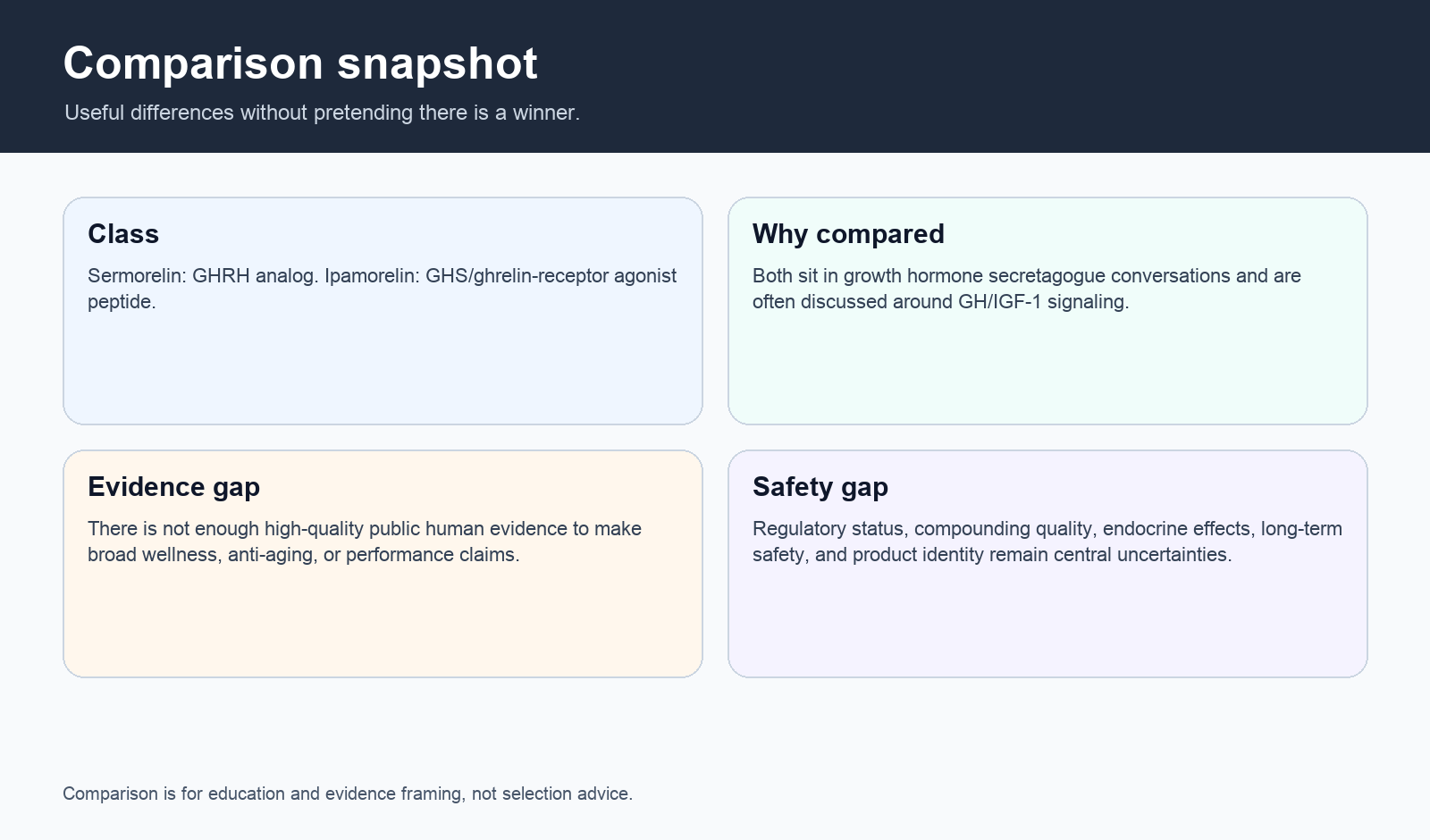
Both pathways are upstream of growth hormone release, but they are not identical levers. That matters when interpreting claims. If a website treats both peptides as interchangeable “GH boosters,” it is probably flattening the biology too much.
Which one has stronger evidence?
The honest answer is that the evidence question depends on what claim is being made.
For mechanism-level claims, both sermorelin and ipamorelin have scientific context around growth hormone release. For broad consumer outcomes such as anti-aging, fat loss, recovery, sleep improvement, performance, or general wellness, the evidence is much weaker and easier to overstate.
This is the trap with growth hormone secretagogue content: a study showing a hormone response is not the same as a study showing a meaningful, durable, safe clinical outcome in the population being marketed to. A growth hormone pulse is a biological signal. It is not automatically a benefit.
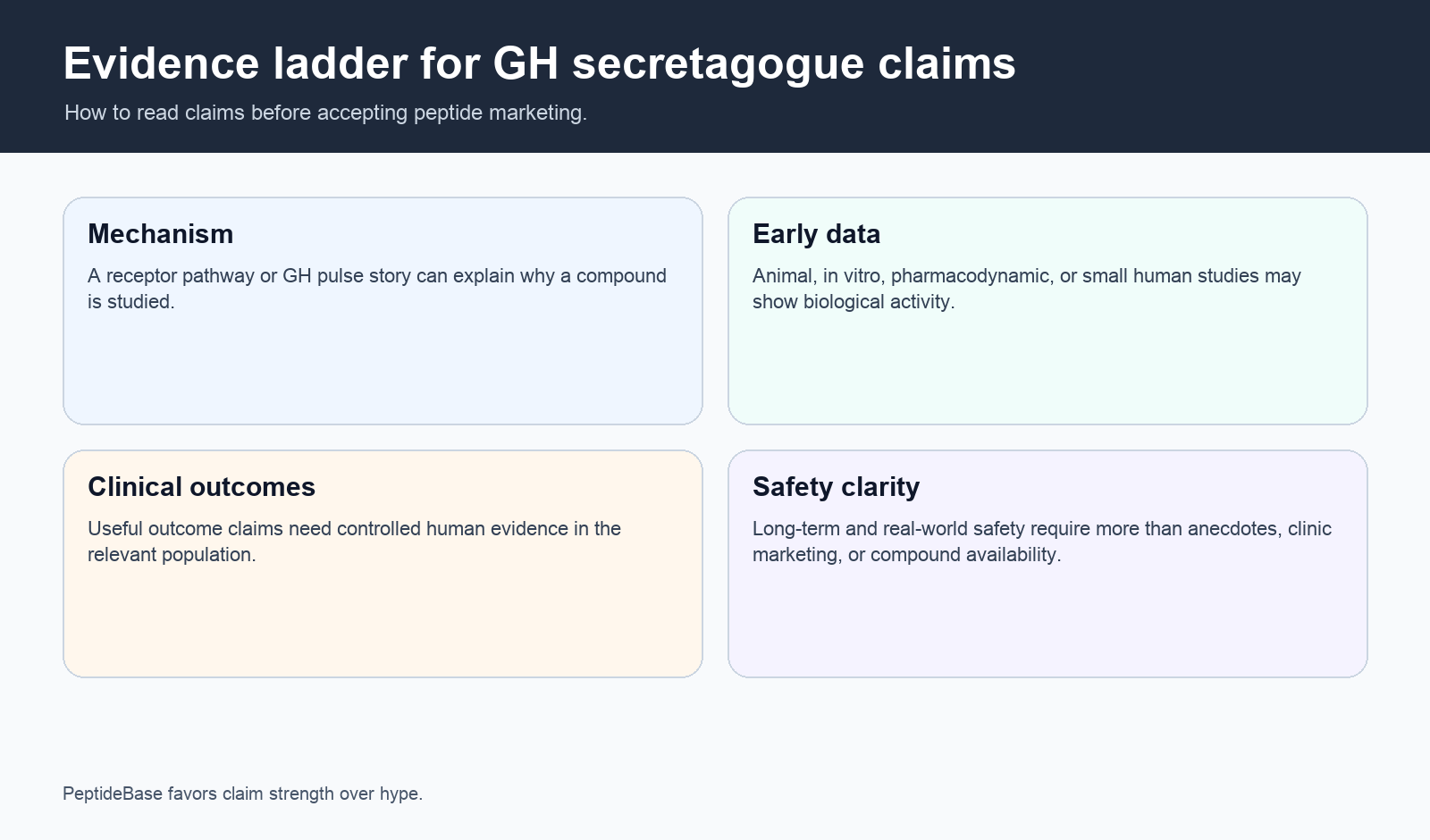
The strongest way to read the evidence is by layers:
- Mechanism plausibility: Does the receptor/pathway story make biological sense?
- Pharmacodynamic data: Does the compound measurably change GH or related markers under study conditions?
- Clinical outcome data: Does it improve a relevant endpoint in controlled human studies?
- Safety data: Are short-term and long-term risks characterized well enough for the claimed use?
Many peptide claims live mostly in layers one and two while advertising themselves like layers three and four.
Side effects and safety uncertainty
Both sermorelin and ipamorelin are discussed around endocrine signaling, so safety uncertainty should not be treated as a footnote. Growth hormone and IGF-1 biology interacts with metabolism, glucose regulation, fluid balance, tissue growth signals, sleep, appetite pathways, and other systems.
Potential concern areas discussed around growth-hormone-secretagogue-related compounds include:
- changes in GH and IGF-1 signaling
- glucose and insulin-sensitivity questions
- water retention or swelling-type symptoms in some GH-related contexts
- headache, flushing, dizziness, or injection-site issues depending on product and use context
- endocrine monitoring uncertainty
- unknown long-term effects in wellness or anti-aging use
- product-quality and compounding variability
- risk of delaying proper diagnosis or standard care
This does not mean every concern applies equally to every person or every compound. It means broad claims like “safe,” “natural,” or “side-effect-free” should be treated as marketing until backed by appropriate evidence.
Regulatory and compounding context
Regulatory status is one of the most confusing parts of peptide content. A peptide can be discussed in medical literature, appear in compounding conversations, be marketed by clinics, and still not have the kind of simple, approved-use status consumers assume from a polished landing page.
FDA compounding materials have discussed ipamorelin and sermorelin in the context of nominated bulk drug substances and compounded products. That does not turn online peptide use into a settled, low-risk consumer category. It mostly shows that regulators, compounders, and clinicians are dealing with a messy gray zone.
The safe editorial position is simple: do not infer legality, quality, approval status, or treatment appropriateness from online availability or clinic marketing.
Why “which is better?” is the wrong question
“Which is better?” sounds practical, but for sermorelin vs ipamorelin it skips too many steps. Better for what? Under what diagnosis? In what population? Measured by GH pulse, IGF-1 change, symptoms, body composition, sleep, adverse effects, or long-term outcomes?
Without that context, “better” usually means “which one is marketed more confidently to the reader’s goal.” That is not evidence. That is sales copy with a lab-coat filter.
A more evidence-aware comparison asks:
- Is the claim mechanism-level or outcome-level?
- Is the evidence human, animal, in vitro, anecdotal, or marketing-derived?
- Is the peptide being discussed as a research compound, a compounded medication, or a clinic service?
- Are side effects and endocrine monitoring discussed as seriously as benefits?
- Is the content giving dosing or sourcing advice instead of evidence framing?
If a comparison article gives you a winner without wrestling with those questions, it is probably doing more persuasion than education.
How sermorelin, ipamorelin, and CJC-1295 fit together conceptually
Sermorelin and CJC-1295 are often grouped conceptually because both are discussed around the GHRH side of growth hormone signaling. CJC-1295 is usually discussed as a longer-acting GHRH analog family topic, with important distinctions between DAC and no-DAC versions.
Ipamorelin is more commonly paired conceptually with GHRP-style or ghrelin-receptor secretagogue discussions. That is why it is often mentioned in the same breath as CJC-1295 in online “stack” conversations: one compound is framed around the GHRH side, the other around the GHS/ghrelin-receptor side.
That conceptual pairing does not make stacking validated, safe, or recommended. It only explains why the names appear together in the same search cluster.
FAQ
Is sermorelin the same as ipamorelin?
No. Sermorelin is generally described as a GHRH analog, while ipamorelin is generally described as a growth hormone secretagogue peptide acting through the ghrelin/GHS receptor pathway. They overlap in growth hormone release discussions but are not the same compound or same pathway.
Is ipamorelin stronger than sermorelin?
“Stronger” is not a clean comparison without defining the endpoint. A hormone response, a receptor effect, and a meaningful clinical outcome are different things. Public evidence does not support a simple universal winner for consumer wellness claims.
Are sermorelin and ipamorelin approved treatments?
Regulatory status depends on the product, indication, jurisdiction, and context. Readers should not assume that online availability, clinic marketing, or compounding references mean a peptide is broadly approved, appropriate, or low risk.
Do sermorelin or ipamorelin increase growth hormone?
Both are discussed because they may stimulate endogenous growth hormone release through different upstream pathways. That mechanism-level statement should not be stretched into broad claims about anti-aging, recovery, fat loss, or performance outcomes.
What are the side effects of sermorelin or ipamorelin?
Reported and theoretical concerns can include endocrine effects, glucose/IGF-1 questions, injection-site issues, headache or flushing-type symptoms, product-quality problems, and unknown long-term safety in wellness use. The specific risk profile depends on context and should be discussed with a qualified clinician.
Why are sermorelin and ipamorelin compared with CJC-1295?
They appear in the same growth hormone secretagogue search cluster. Sermorelin and CJC-1295 are discussed around GHRH-type signaling, while ipamorelin is discussed around GHS/ghrelin-receptor signaling. That explains the comparison, but it does not validate stack claims.
Bottom line
Sermorelin and ipamorelin are compared because both are discussed around endogenous growth hormone release, but they are not interchangeable. Sermorelin is the GHRH-analog side of the conversation. Ipamorelin is the ghrelin/GHS receptor secretagogue side. The important difference is mechanism; the important limitation is evidence.
Neither peptide should be presented as a proven wellness shortcut, an anti-aging answer, or a self-directed treatment choice. A careful comparison should help readers understand the biology, the evidence gaps, and the safety uncertainty without nudging them toward protocols, purchases, or recommendations.