BPC-157 and TB-500 are often mentioned together because both are discussed for healing and recovery, but they are not interchangeable and the better choice of article framing is usually not "which one is better?" but "what kind of recovery problem is being explored, and how weak is the evidence behind each option?"
Quick answer: BPC-157 is usually discussed more broadly, especially around tendon, ligament, gut, and general recovery claims. TB-500 is more commonly framed around soft-tissue repair, mobility, and recovery signaling tied to thymosin beta-4 biology. Both have more hype online than strong human clinical certainty.
Quick comparison snapshot
| Category | BPC-157 | TB-500 | |---|---|---| | Main reputation | broad healing and gut-support discussions | soft-tissue recovery and repair-signaling discussions | | Biological story | repair-related and protective signaling across multiple tissues | thymosin beta-4-related repair, cell migration, and tissue-organization signaling | | Online popularity | very high | high, often paired with BPC-157 | | Human evidence quality | limited | limited | | Main caution | broad claims often get exaggerated | plausible recovery story can sound more proven than it is |
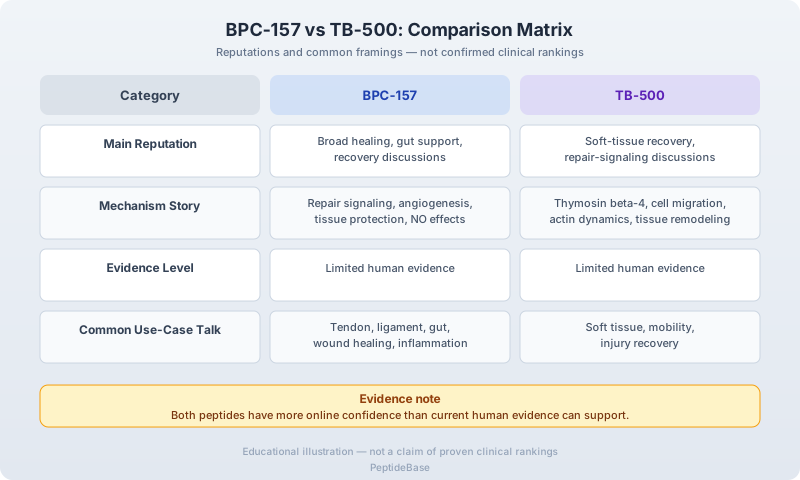 A comparison matrix helps readers see where BPC-157 and TB-500 overlap and where they diverge.
What is the real difference between BPC-157 and TB-500?
The cleanest difference is that BPC-157 is usually discussed as a broader healing peptide, while TB-500 is usually framed as a more recovery- and tissue-repair-focused peptide related to thymosin beta-4 activity.
That does not mean BPC-157 is proven for all the extra things people mention, and it does not mean TB-500 has cleaner clinical validation just because its story sounds more focused. It mostly means the internet has built different reputations around two evidence-limited compounds.
Quick answer: Are BPC-157 and TB-500 the same thing?
No. They are different peptides with different mechanism stories, different reputations, and different common use-case discussions, even though they often show up in the same recovery conversations.
How BPC-157 is usually framed
BPC-157 is usually framed as the broader "healing peptide." People often look it up for tendon issues, ligament recovery, muscle repair, gut support, inflammation-related recovery, and wound-healing discussions.
That broader framing is part of why BPC-157 became such a magnet for hype. Once a compound gets discussed for connective tissue, digestion, inflammation, and recovery all at once, internet logic starts treating it like duct tape for the human body.
What is more defensible is this: BPC-157 has preclinical signals that make it worth studying, but the breadth of claims should make cautious readers more skeptical, not less.
A separate self-assembling peptide tendon study reported promising rat and beagle findings for AsPep-FTSQ, but those results cannot be transferred to BPC-157 or TB-500 and still do not establish tendon repair in humans.
How TB-500 is usually framed
TB-500 is usually framed as the more soft-tissue-specific recovery peptide, especially in conversations about mobility, tissue repair, cell migration, and injury recovery. Its story is tied to thymosin beta-4-related biology, which gives it a more "mechanistic" reputation in some circles.
That cleaner narrative can make TB-500 sound more established than it really is. A peptide having a nice biological storyline is common. A peptide having strong, consistent, real-world human outcome data is much rarer.
Quick answer: Is TB-500 better for injuries?
TB-500 is often discussed more specifically in injury-recovery contexts, but current evidence is not strong enough to say it is clearly better in a broad, high-confidence clinical sense.
Mechanism comparison: how are they supposed to work?
The mechanism comparison matters because many readers are really asking whether the peptides overlap or complement each other.
BPC-157 mechanism story
BPC-157 is often discussed in relation to repair signaling, angiogenesis, tissue protection, nitric-oxide-related effects, and gastrointestinal support. The mechanism story is broad and sometimes a little too convenient, which is why writers should resist turning it into a magical all-systems repair tool.
TB-500 mechanism story
TB-500 is often discussed in relation to cell migration, actin dynamics, tissue remodeling, angiogenesis, and repair pathways associated with thymosin beta-4. It tends to sound narrower and more recovery-centered.
Quick answer: Do BPC-157 and TB-500 overlap?
Yes. They overlap in recovery and repair discussions, but they get there through different proposed mechanisms and different public reputations.
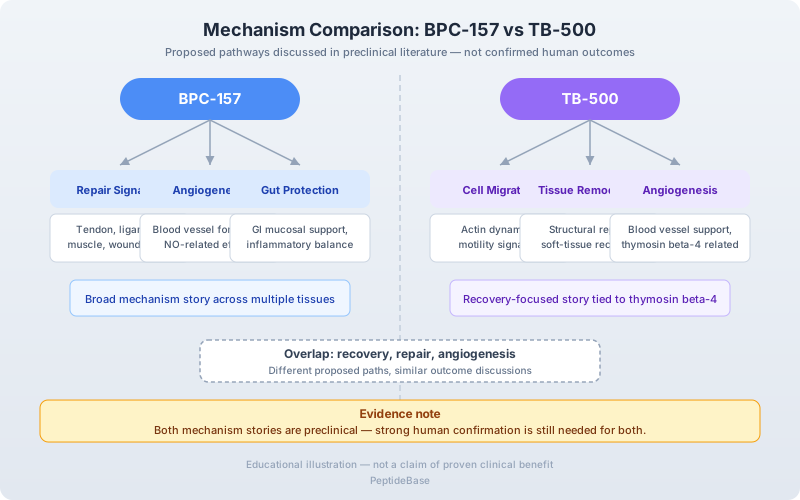 A split mechanism diagram can clarify why the peptides are discussed differently without overstating certainty.
Which one is more commonly discussed for gut issues, tendon issues, and general recovery?
If the question is about gut-related or broader healing discussions, BPC-157 is usually the peptide people bring up first.
If the question is about soft tissue, mobility, and more injury-specific recovery framing, TB-500 is usually the one that gets mentioned more often.
If the question is simply general recovery, both show up, and that is where clarity matters. "Recovery" is a vague umbrella word. Readers are better served by breaking it into tendon, ligament, muscle, gut, post-training soreness, or wound-healing interest.
Which one has better evidence?
Neither peptide has the kind of strong human evidence that justifies high-confidence claims. That is the boring answer, which is probably why so many websites avoid saying it plainly.
BPC-157 has enormous online momentum, a broad claim surface, and a lot of anecdotal enthusiasm. TB-500 has a more focused recovery narrative and a plausible biological basis tied to thymosin beta-4. Neither of those facts solves the core issue: limited robust human trial data.
Quick answer: Is BPC-157 better studied than TB-500?
BPC-157 is often discussed more widely, but wider discussion is not the same as better human evidence. Both remain evidence-limited topics.
Side effects, safety, and uncertainty: which is safer?
The most honest answer is that neither peptide can be described as clearly safe in a broad, high-confidence way. Human safety data are limited, sourcing is often inconsistent, and real-world use frequently happens outside regulated medical channels.
Shared risk issues include:
- uncertain product purity
- inconsistent dosing and concentration
- gray-market sourcing problems
- injection-related issues when used that way
- unrealistic expectations leading people to skip diagnosis, rehab, or standard care
- limited long-term human safety clarity
If someone is trying to choose between two uncertain compounds while ignoring a major injury, that is not optimization. That is denial with branding.
Can BPC-157 and TB-500 be stacked?
Yes, they are often discussed together in stacks, especially in recovery communities, but "commonly stacked" should never be confused with "well validated." Stacking can make the logic feel more sophisticated while actually making attribution, safety, and outcome interpretation worse.
Our examination of BPC-157 and TB-500 together looks more closely at the combination evidence, overlapping claims, and added uncertainty.
Quick answer: Does stacking BPC-157 and TB-500 solve the uncertainty problem?
No. Stacking increases complexity, and it does not magically create strong human evidence where it does not already exist.
Who is each one a better fit for — conceptually?
Conceptually, BPC-157 is the better fit for readers exploring broader healing or gut-related questions.
Conceptually, TB-500 is the better fit for readers exploring soft-tissue recovery, mobility, or repair-signaling questions.
But if the reader wants a peptide with well-established medical standards, strong regulatory clarity, and highly predictable clinical outcomes, neither one is an especially comfortable answer.
Decision guide: which comparison question actually matters?
The best comparison is usually not "which peptide wins?" It is one of these:
- Is the goal gut-related, soft-tissue-related, or just vaguely "recovery"?
- Is the reader looking for a research topic or a clinically settled option?
- Is the real need rehab, diagnosis, or imaging rather than more peptide theory?
- Is the person underestimating sourcing and safety risk because online communities make this sound routine?
That last one matters more than people like to admit. A lot of "optimization" content is just uncertainty wearing sunglasses.
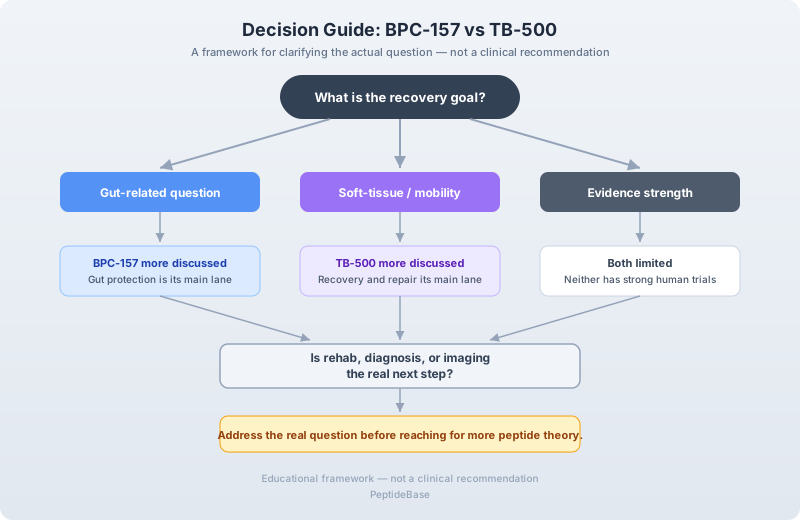 A decision-tree visual can turn a vague peptide comparison into a clearer question about use case and evidence quality.
FAQ
Which is better, BPC-157 or TB-500?
Neither is clearly "better" in a universal sense. BPC-157 is usually framed more broadly, while TB-500 is usually framed more specifically around recovery and soft tissue, but both remain evidence-limited.
Is BPC-157 better for gut issues?
In common peptide discussions, yes, BPC-157 is more closely associated with gut-related questions than TB-500.
Is TB-500 better for injury recovery?
TB-500 is more often discussed in that context, but the evidence is not strong enough to treat that framing as proven clinical fact.
Are BPC-157 and TB-500 safe together?
There is not enough high-quality evidence to make broad, confident safety claims about stacking them. Product quality and sourcing uncertainty add another layer of risk.
Which one is more evidence-based?
Neither one has strong enough human evidence to deserve high-confidence language. The better move is to stay specific, skeptical, and honest about uncertainty.
Bottom line
BPC-157 and TB-500 overlap heavily in recovery conversations, but they occupy different reputational lanes. BPC-157 is usually the broader healing and gut-support peptide discussion. TB-500 is usually the more soft-tissue-repair and thymosin beta-4-related discussion. The main thing they truly share is this: both are surrounded by more confidence online than the current human evidence can comfortably support.
This article is for educational purposes only and is not medical advice. Human evidence remains limited, and anyone considering peptide use should weigh regulatory issues, sourcing quality, personal health risks, and clinician guidance carefully.