BPC-157: What It Is, What It May Do, and What the Evidence Actually Shows
BPC-157 is a peptide commonly discussed for healing, recovery, and gut support, but the strongest claims around it still move faster than the quality of human evidence.
BPC-157 is a synthetic peptide most often discussed for healing, tissue repair, gut protection, and recovery, but the strongest claims around it still outrun the quality of published human evidence.
Quick answer: BPC-157 is short for Body Protection Compound-157, a peptide fragment studied mostly in preclinical settings. It is commonly talked about for tendon, ligament, muscle, gut, and wound-healing support, but human data remain limited and the certainty level should stay modest.
Quick facts
- Full name: Body Protection Compound-157
- Main reputation: healing and recovery peptide
- Most common interest areas: soft tissue, gut-related questions, recovery
- Evidence quality: mostly preclinical, limited human clarity
- Big caution: online certainty is much higher than the literature warrants
- Bottom-line framing: interesting research topic, not a proven cure-all
What is BPC-157?
BPC-157 is a synthetic peptide fragment that has attracted attention because of preclinical research into tissue repair, angiogenesis, inflammation-related signaling, and gastrointestinal protection. It is usually described as a research peptide rather than a mainstream, well-established medical therapy.
The reason people keep asking about it is simple: the claims are broad. BPC-157 is often discussed for tendon injuries, ligament issues, muscle recovery, gut irritation, wound repair, and sometimes even nerve-related recovery questions. That breadth is exactly why caution matters. When one compound is said to help almost everything, good skepticism is not negativity — it is basic hygiene.
Quick answer: Is BPC-157 a real peptide?
Yes. BPC-157 is a real synthetic peptide fragment studied in research settings, but that does not mean every online claim about it is clinically proven or medically reliable.
How is BPC-157 supposed to work?
BPC-157 is generally discussed as affecting repair-related signaling, blood-vessel formation, inflammatory balance, and tissue adaptation after injury or stress. Depending on the paper or theory being cited, people connect it with angiogenic signaling, nitric-oxide-related effects, tendon and ligament healing pathways, and protective effects in gastrointestinal tissue.
In plain English, the argument is that BPC-157 may help create better repair conditions in stressed or damaged tissue. That is a reasonable research hypothesis. It is not the same as having strong human trial evidence showing predictable clinical outcomes.
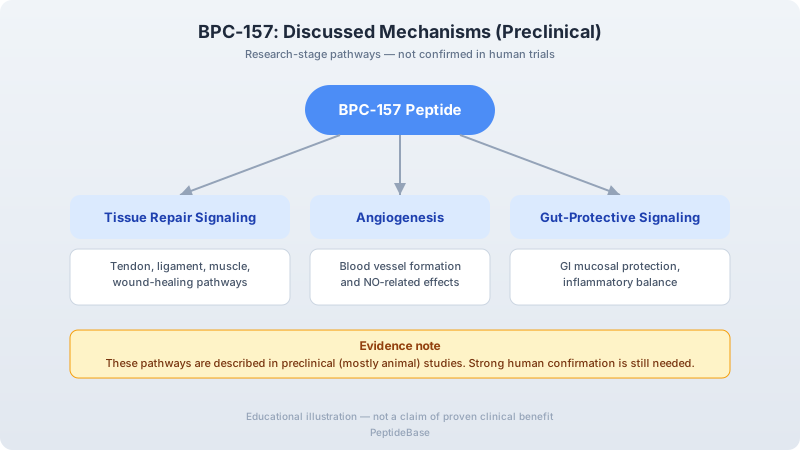 A mechanism diagram can help explain why BPC-157 is discussed so broadly while still separating theory from proven human benefit.
What benefits is BPC-157 commonly discussed for?
BPC-157 is commonly discussed for healing and recovery, but the confidence level should vary by claim.
Claims that are often discussed include:
- Tendon and ligament support: one of the most common reasons people research it
- Muscle recovery: frequently discussed, especially in training and injury circles
- Gut protection or repair support: another major reason BPC-157 gets attention
- Wound healing: biologically plausible, though still easy to overstate
- Inflammation-related recovery support: possible in theory, but often described too confidently online
Quick answer: Does BPC-157 heal injuries?
Research suggests BPC-157 may influence pathways involved in tissue repair, but current evidence is not strong enough to say it reliably heals injuries in humans across real clinical settings.
Where BPC-157 may fit best — and where it may not
BPC-157 makes the most sense as a topic for readers exploring recovery, soft-tissue healing, or gut-related peptide discussions. It is much less compelling if the reader wants a well-validated, standardized, guideline-backed intervention with clear regulatory footing.
It is also not ideal for people who want certainty. If your standard is "interesting mechanism and promising animal data," BPC-157 qualifies. If your standard is "large, consistent human trials with settled clinical use," it does not.
How long does BPC-157 take to work?
Any timeline discussion should be framed carefully because tissue type, severity, underlying condition, overall recovery strategy, and expectation bias all affect what people think they notice.
Anecdotal discussions often break down like this:
- Days to 2 weeks: perceived changes in soreness, gut comfort, or mobility
- 2 to 6 weeks: subjective recovery changes people often report in soft-tissue contexts
- Longer timelines: more meaningful structural healing claims would reasonably require more time and much better evidence
Quick answer: How quickly does BPC-157 work?
People often expect early subjective changes within days or weeks, but stronger claims about true tissue repair need better evidence and longer observation than anecdotes usually provide.
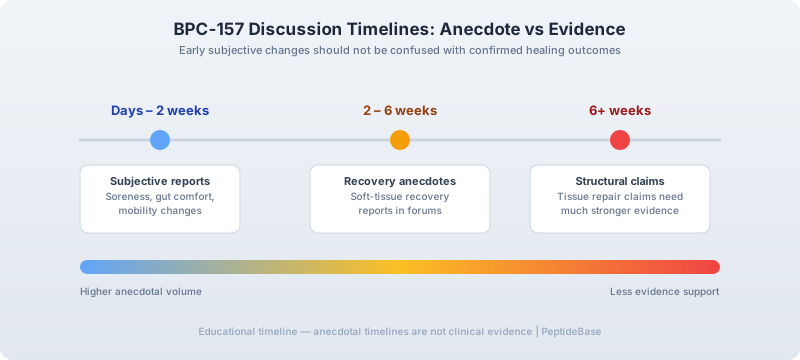 A timeline graphic can show why early anecdotal changes should not be confused with confirmed long-term healing outcomes.
What are the side effects and risks of BPC-157?
The risk picture around BPC-157 is not just about immediate side effects. It is also about uncertainty, sourcing, purity, self-experimentation, and the tendency to mistake a gray-market product for a validated therapy.
Potential concerns include:
- product contamination or mislabeling
- inconsistent potency between sources
- injection-related irritation when used outside proper medical supervision
- limited long-term human safety data
- overconfidence that leads someone to ignore rehab basics or formal diagnosis
- unknown interaction risks in people with more complicated medical situations
Quick answer: Is BPC-157 safe?
BPC-157 cannot be called clearly safe in a broad, high-confidence way because human safety data are limited and real-world product quality is often inconsistent.
Who should be especially cautious or avoid it?
People with significant injuries, unexplained pain, gastrointestinal bleeding concerns, pregnancy or breastfeeding questions, active cancer-related concerns, upcoming surgery, or complex chronic disease should be especially cautious and should not treat peptide content as a substitute for professional care.
Athletes should also take anti-doping rules seriously. "I found it on the internet" is not a defense strategy. It is barely a life strategy.
What does the evidence actually show?
The evidence for BPC-157 is interesting, but it is not strong in the way internet discussion often implies.
What supports interest:
- preclinical studies suggest repair-related and protective effects in several tissues
- there is a plausible biological story around healing, angiogenesis, and tissue adaptation
- the peptide has become a persistent topic because the mechanism story is broad and intuitively appealing
What weakens confidence:
- limited robust human clinical trial data
- uncertain standardization across products used outside formal research settings
- broad claims that sometimes leap far beyond published evidence
- incomplete long-term safety clarity
Quick answer: Is the evidence for BPC-157 strong?
No. The evidence is promising enough to justify curiosity, but not strong enough to justify certainty.
BPC-157 vs TB-500
BPC-157 and TB-500 are often grouped together because both are discussed for healing and recovery, but they are not interchangeable.
| Topic | BPC-157 | TB-500 | |---|---|---| | Main reputation | healing, gut support, recovery | soft-tissue recovery, repair signaling | | Mechanism story | broad repair and protective signaling | thymosin beta-4-related repair signaling | | Common comparison reason | gut + tendon interest | tendon + recovery interest | | Evidence quality | limited human certainty | also limited human certainty |
The better question is usually not "which one is best?" It is "what exact problem is the reader trying to solve?" Vague goals produce vague peptide shopping, and that is how people end up treating internet folklore like a treatment plan.
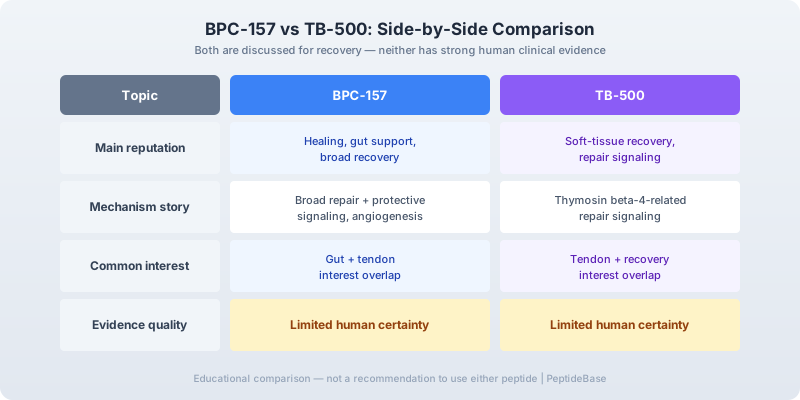 A comparison visual helps readers understand where BPC-157 and TB-500 overlap and where the evidence remains thin.
Is there a standard dosage or protocol?
There is no universally accepted, high-confidence BPC-157 dosing standard that cautious readers should treat as settled clinical guidance. Protocol discussions online vary widely, often without strong context around evidence quality, sourcing, or supervision.
Educationally, the smarter takeaway is that limited human evidence and inconsistent supply chains make precision harder than forum posts suggest.
FAQ
What is BPC-157 used for?
BPC-157 is usually discussed for tendon, ligament, muscle, gut, wound, and general recovery questions, but those uses are supported more by preclinical research and anecdote than by strong human outcome data.
Is BPC-157 legal?
Legal and regulatory status varies by jurisdiction, product category, and intended use. Readers should verify current local rules rather than assuming legality from online sales pages.
Is BPC-157 banned in sport?
Athletes should check current anti-doping policies directly with the relevant governing body because peptide-related rules can matter even when online discussions gloss over them.
Can BPC-157 be stacked with other peptides?
It is often discussed in stacks, especially with TB-500, but stacking increases complexity and does not solve the underlying evidence or safety limitations.
Is BPC-157 worth considering?
It is worth understanding as a research topic and a common recovery discussion point. It is not worth treating as a guaranteed shortcut or a substitute for real diagnosis, rehab, or evidence-backed care.
Bottom line
BPC-157 is one of the most talked-about healing peptides because the mechanism story is appealing and the use cases sound broad. The catch is the usual one: interesting biology does not automatically equal proven clinical benefit. The most defensible view is that BPC-157 is a promising but evidence-limited peptide topic with meaningful uncertainty around safety, sourcing, and real-world reliability.
This article is for educational purposes only and is not medical advice. Human evidence remains limited, and anyone considering peptide use should weigh product quality, regulatory issues, and personal health risks with a qualified clinician.