Best Peptides for Recovery: Evidence-Aware Comparison
Search for the "best peptides for recovery" and you will usually find certainty moving much faster than evidence. The same few names appear again and again: BPC-157, TB-500, GHK-Cu, collagen peptides, growth-hormone secretagogues, and sometimes GLP-1 or metabolic peptides dragged into the discussion because the internet treats categories like a junk drawer with Wi-Fi.
This article compares recovery-related peptides by evidence quality and uncertainty, not by personal-use recommendations. The goal is to help readers understand which claims are supported by human evidence, which are mostly preclinical, which are mechanistic, and which are marketing-shaped fog with a citation taped to it.
Educational note: This article is for general information only. It is not medical advice, treatment guidance, dosing guidance, sourcing guidance, purchasing guidance, or a recommendation to use any peptide.
Quick answer: what are the "best peptides for recovery" by evidence quality?
There is no honest universal ranking of the "best peptides for recovery" for personal use. The evidence depends on what kind of recovery you mean: wound healing, tendon or ligament injury, muscle soreness, surgical recovery, skin repair, sleep, inflammation, or general training readiness.
A more responsible framework looks like this:
- Stronger human relevance: collagen peptides for connective-tissue nutrition and exercise-support contexts, though results depend on study design, protein intake, training, and outcome measured.
- Approved medical peptides with recovery-adjacent relevance: some peptide drugs have clinical evidence for specific approved uses, but that does not automatically translate to general injury or workout recovery claims.
- Popular but mostly preclinical recovery peptides: BPC-157 and TB-500 are widely discussed online, but many claims rely on animal studies, mechanistic reasoning, or anecdote rather than mature human evidence.
- Skin and tissue-support discussion: GHK-Cu has cosmetic and wound-healing-adjacent interest, but claims should be separated by topical/cosmetic context, preclinical data, and human relevance.
- Indirect recovery claims: sleep, appetite, weight, or hormone-related peptides may affect recovery indirectly in specific medical contexts, but online claims often overextend beyond the evidence.
The cleanest answer is boring, which is usually where the truth keeps its office: compare the evidence level before comparing the peptide.
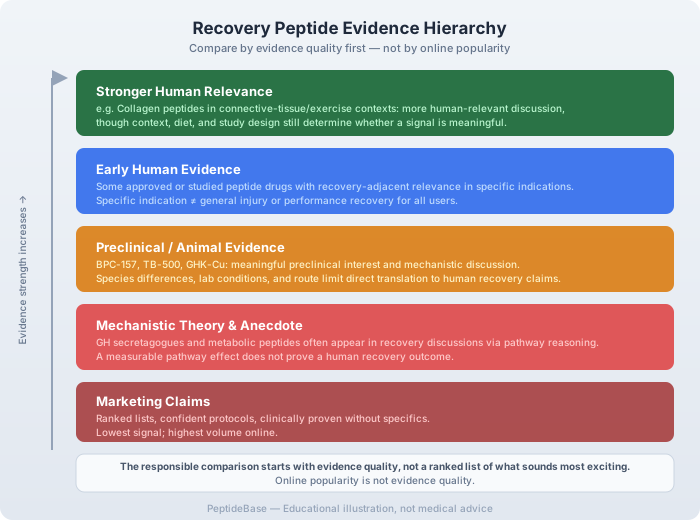
The responsible comparison starts with evidence quality, not a ranked list of what sounds most exciting.
What "recovery" means changes the answer
Recovery is not one outcome. That is the first trap.
A peptide discussed for "recovery" might be framed around:
- tendon or ligament healing
- muscle damage after exercise
- wound healing
- skin repair
- joint discomfort
- inflammation signaling
- sleep quality
- appetite or body composition
- surgical recovery
- return-to-training readiness
- general fatigue
Those are different biological and clinical questions. Evidence for one does not prove another. A compound that influences wound signaling in an animal model has not automatically been shown to help a recreational athlete recover from a hard leg day. A peptide with an approved medical role in one condition is not automatically a general recovery tool.
When content collapses all recovery claims into one bucket, the article becomes easier to sell and harder to trust. Convenient, really. Like a suitcase with no compartments and a dead fish in it.
How to read the comparison table
The table below is not a recommendation list. It is an evidence-orientation tool.
| Peptide or category | Why it appears in recovery discussions | Evidence posture | Main uncertainty | |---|---|---|---| | Collagen peptides | Connective-tissue nutrition, tendon/ligament support discussions, exercise studies | More human-relevant than many internet "recovery peptides," but not magic and not peptide-drug equivalent | Effects vary by training context, total diet, outcome, dose/formulation in studies, and study quality | | BPC-157 | Tissue repair, tendon/ligament, gut, inflammation, injury-recovery claims | Popular online; much discussion is preclinical, mechanistic, or anecdotal | Limited mature human evidence for broad recovery claims; product quality and regulatory uncertainty matter | | TB-500 / thymosin beta-4 related discussion | Cell migration, tissue repair, wound-healing and recovery-adjacent claims | Preclinical and mechanistic interest; online use claims often outrun human evidence | Translation from thymosin beta-4 research to commercial TB-500 claims is often unclear | | GHK-Cu | Skin repair, cosmetic use, wound-healing-adjacent mechanisms | Some topical/cosmetic and mechanistic interest; claim strength depends heavily on route/context | General recovery claims can overextend beyond skin/cosmetic or early evidence contexts | | Growth hormone secretagogues | Sleep, body composition, GH/IGF-1 pathway, training recovery claims | Some compounds have human research in specific contexts, but wellness claims are often broader | Hormonal pathway changes do not equal safe or useful recovery outcomes for general users | | GLP-1 and metabolic peptides | Weight change, inflammation/metabolic health, indirect recovery discussion | Strong clinical evidence for approved indications in some agents, but not "recovery peptide" evidence in the usual online sense | Medical-use evidence should not be repackaged as general performance recovery advice |
The practical takeaway: the online popularity of a peptide is not the same as evidence quality. Sometimes popularity just means the marketing found a bigger microphone.
For a closer comparison of the two compounds that dominate these discussions, see BPC-157 vs TB-500, including how their claimed use cases and evidence gaps differ.
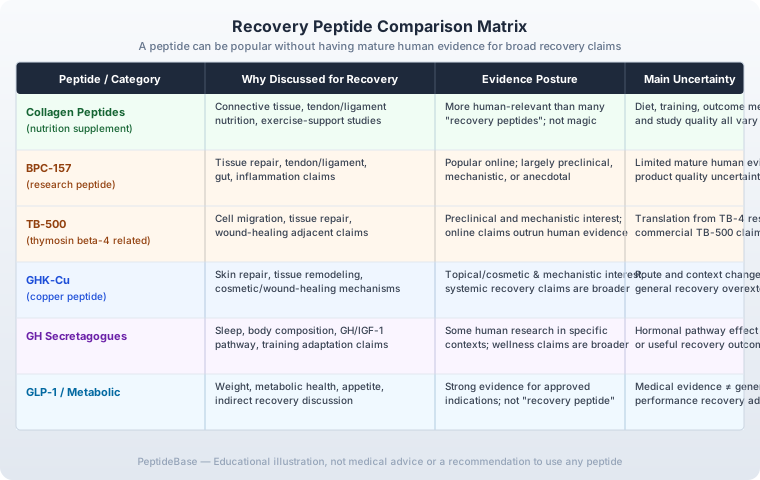
A peptide can be popular in recovery discussions without having mature human evidence for broad recovery claims.
Collagen peptides: more human-relevant, but often over-sold
Collagen peptides are different from many compounds that appear in peptide-recovery discussions. They are commonly sold as nutrition supplements rather than research peptides, and they have more human-relevant discussion around connective tissue, tendons, ligaments, joint comfort, and exercise-support contexts.
That does not make collagen peptides a universal recovery answer. Human studies can vary in design, population, training program, outcomes measured, and how collagen intake fits into total protein, vitamin C status, rehab, and load management. A positive signal in one context should not be inflated into "repairs injuries" or "fixes joints."
Collagen is best understood as a nutrition-adjacent category with some plausible and studied recovery-related contexts. It is not comparable to claiming an experimental peptide directly heals a tendon in humans because someone found an animal study and got excited in a comment section.
BPC-157: popular recovery claims, limited mature human clarity
BPC-157 is one of the most common names in online recovery discussions. It is often associated with tendon, ligament, muscle, gut, inflammation, and general healing claims. The problem is that the confidence online frequently exceeds the maturity of the public human evidence.
Much of the BPC-157 discussion leans on preclinical research, mechanistic reasoning, and user reports. Those can be interesting, but they are not the same as controlled, replicated human evidence showing meaningful recovery outcomes with clear safety data.
A careful BPC-157 article should separate:
- what has been explored in preclinical models
- what mechanisms are proposed
- what human evidence is limited or absent for broad claims
- what safety and product-quality uncertainties remain
- what claims are anecdotal or marketing-led
BPC-157 may be biologically interesting. But "interesting" is not a treatment plan. It is barely a first date.
TB-500 and thymosin beta-4: translation matters
TB-500 is commonly discussed in recovery circles because of its relationship to thymosin beta-4 themes: tissue repair, cell migration, wound healing, and recovery-adjacent mechanisms. Online content often treats this as straightforward. It is not.
The key issue is translation. Research on thymosin beta-4, fragments, mechanisms, or animal models does not automatically validate commercial TB-500 claims for human recovery. The exact compound, formulation, route, purity, outcome, and population matter.
For readers, the safest question is: What exactly was studied, and does it match the claim being made? If the claim moves from a preclinical model to "best for tendon recovery" without explaining the evidence gap, you are not reading a comparison. You are reading confidence cosplay.
TB-500 belongs in an evidence-aware comparison because people search for it, not because it should be presented as a proven recovery option.
GHK-Cu: skin, tissue signaling, and context creep
GHK-Cu, often called copper peptide, appears in discussions around skin, cosmetic use, tissue remodeling, wound-healing mechanisms, and sometimes broader recovery claims. This is a good example of why route and context matter.
A topical cosmetic or skin-focused discussion is not the same as a systemic recovery claim. Evidence related to skin appearance, wound environments, or cellular mechanisms should not be stretched into broad statements about muscle, tendon, or injury recovery unless the evidence directly supports that leap.
GHK-Cu may be relevant to a recovery comparison as a skin and tissue-support topic, but it should be framed carefully. The more general the claim becomes, the higher the evidence burden should be.
Growth hormone secretagogues: indirect recovery claims need caution
Growth hormone secretagogues and related compounds are sometimes discussed as recovery peptides because of sleep, body composition, growth hormone signaling, IGF-1 discussions, or training adaptation. This is where mechanism inflation gets especially tempting.
A measurable hormone-pathway effect does not automatically prove better recovery, lower injury risk, safer training, or improved performance for general users. Endocrine systems are not vending machines. You do not press "more pathway" and receive "better outcome."
Some compounds in this broad area have been studied in humans for specific contexts, but online recovery claims often blur medical research, anti-aging marketing, bodybuilding folklore, and general wellness language. That blur should make readers more cautious, not more convinced.
GLP-1 and metabolic peptides are not the same recovery category
GLP-1 receptor agonists and other metabolic peptide drugs may appear in peptide lists because they are peptide-based or peptide-adjacent therapies with strong medical relevance in approved contexts. But calling them "recovery peptides" can be misleading.
Weight change, metabolic health, appetite, inflammation markers, sleep, and mobility can all influence how someone feels or functions. But that does not make an approved metabolic therapy a general recovery recommendation. Medical evidence for one indication should not be repackaged into broad recovery content for SEO convenience.
This distinction matters because "peptide" is a chemistry category, not a recovery strategy.
Red flags in "best recovery peptide" lists
Be skeptical when a page:
- ranks peptides without explaining evidence levels
- treats animal studies as human proof
- gives protocols or dosing inside a supposedly educational guide
- links directly into buying funnels while claiming neutrality
- uses "clinically proven" without specifying the exact human evidence
- ignores product quality, contamination, and regulatory uncertainty
- frames every peptide as best for a different recovery problem with no downside
- treats side effects as an afterthought
- never says "unknown"
The absence of uncertainty in peptide content is not a trust signal. It is usually a warning light with better typography.
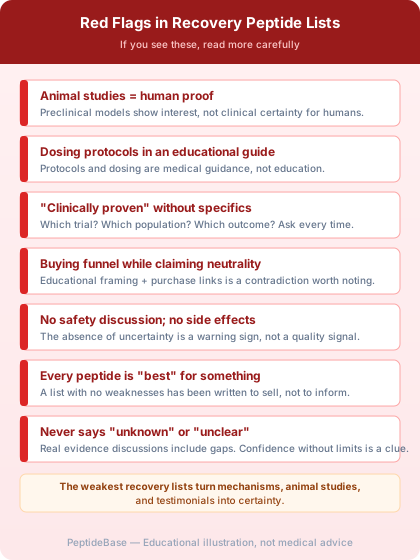
The weakest recovery lists usually turn mechanisms, animal studies, and testimonials into certainty.
A better way to compare recovery-related peptides
Instead of asking "which peptide is best," ask:
- What recovery outcome is being claimed? Tissue healing, soreness, sleep, skin, surgery, training readiness, or something else?
- What type of evidence supports it? Human trial, animal model, cell study, mechanism, anecdote, or marketing?
- Does the studied compound match the claim? Same molecule, route, formulation, and population?
- Were real outcomes measured? Or just biomarkers, tissue signals, or subjective reports?
- What is known about safety? Short term, long term, rare events, product-quality risk, and vulnerable groups?
- Is the content educational or recommendation-like? Is it pushing a decision while pretending not to?
That framework is less exciting than a ranked list. It is also less likely to mislead you.
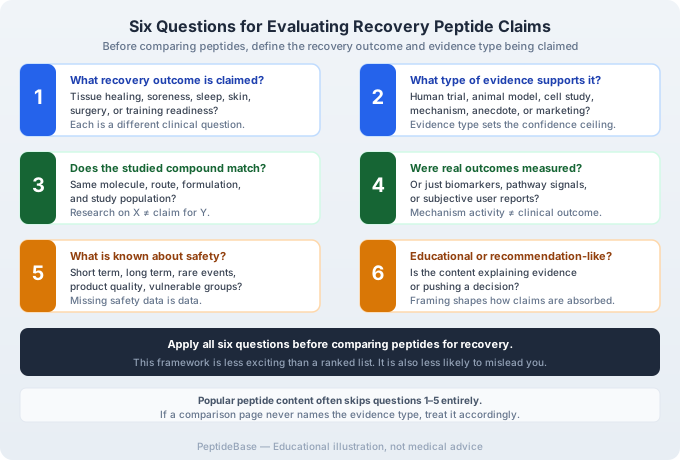
Before comparing peptides, define the recovery outcome and evidence type being claimed.
Evidence-aware comparison summary
If we group recovery-related peptides by evidence posture rather than hype, the picture looks like this:
- More human-relevant nutrition-adjacent category: collagen peptides, especially when discussed in specific connective-tissue or exercise-support contexts rather than as injury cures.
- High online interest but weaker public human recovery evidence: BPC-157 and TB-500, especially for broad tendon, ligament, muscle, or injury-recovery claims.
- Context-limited tissue/skin discussion: GHK-Cu, where route and claim scope matter heavily.
- Indirect and often overextended recovery framing: growth-hormone secretagogues and metabolic peptide drugs when marketed beyond studied contexts.
That does not mean every weakly supported claim is false. It means the confidence should match the evidence. Most online lists turn the volume up before checking whether the speakers are plugged in.
What this article does not do
This article does not recommend peptides for recovery. It does not provide dosing, protocols, timing schedules, administration instructions, purchasing guidance, sourcing advice, or treatment instructions. It does not tell readers what to use for injuries, pain, surgery, training, or medical conditions.
If you are dealing with an injury, persistent pain, slow healing, fatigue, surgery recovery, or a medical condition, the right next step is a qualified health professional, not an internet ranking page.
FAQ
What peptide has the best evidence for recovery?
There is no single "best peptide for recovery" across all recovery outcomes. Collagen peptides have more human-relevant discussion in some connective-tissue and exercise-support contexts than many internet recovery peptides, but they should not be treated as universal injury treatments.
Are BPC-157 and TB-500 proven for human recovery?
Broad human recovery claims for BPC-157 and TB-500 should be treated cautiously. Much online discussion relies on preclinical evidence, mechanisms, and anecdote rather than mature, replicated human evidence for specific recovery outcomes.
Are collagen peptides the same as research peptides?
No. Collagen peptides are usually discussed as nutrition supplements, while compounds such as BPC-157 or TB-500 are often discussed as research or experimental peptides. They should not be evaluated as if they belong to the same evidence and regulatory category.
Can peptides speed injury healing?
Some peptides are studied in healing-related contexts, but online claims often overstate what is known. Injury healing depends on diagnosis, tissue type, severity, rehab, nutrition, sleep, medical care, and time. Do not use online peptide content as treatment guidance.
Why do so many peptide recovery pages sound confident?
Because confidence sells. Recovery pages often blend animal studies, mechanisms, testimonials, and commercial incentives into a simple ranking. Evidence-aware content should separate those categories and state uncertainty clearly.
Should I use peptides for recovery?
This article cannot answer that and does not recommend peptide use. If you have a recovery, injury, or medical concern, talk to a qualified healthcare professional.